

Fragile Minerals: How to Handle Them Without Damage
Handle a fragile mineral with clean, lotion-free hands, hold it from below with both hands, and keep it over a padded tray. Never lift it by its crystals. That routine prevents most breakage, and the rest of this guide covers cleaning, storage, moving and the species that need extra care. Pieces from our museum-quality minerals and crystals range are the kind of specimens this routine is written for.
TL;DR
- Use both hands, support the piece from below, and work over a padded tray or box.
- Lift by the matrix or base, never by crystals, repairs or projections.
- Dry-clean first with a soft natural-hair brush. Avoid harsh chemicals and test any method on a small, discardable fragment.
- Store each specimen separately on padded supports, and keep pyrite below 45% relative humidity.
- Some minerals are toxic or radioactive. Wear gloves and wash your hands after handling.
Table of Contents
- Why fragile minerals break
- How to pick up and hold a specimen
- Cleaning fragile specimens
- Storing and displaying fragile minerals
- Moving and shipping delicate pieces
- Minerals that need safety precautions
- Fixing, gluing and stabilizing
- Choosing specimens you can handle with confidence
- FAQ
- Sources
Why fragile minerals break
The Canadian Conservation Institute (CCI), part of the federal government, states that physical force is the most common agent of deterioration for rocks and minerals. Knocks against hard surfaces and vibration in storage or display cause fissures, cracks, breaks, losses and surface abrasion.
Hardness is not toughness. A guide to collector crystals points out that a hard mineral can still snap or cleave. Quartz scratches steel, yet a thin quartz point can shear off in a careless grip.
An Australian museum manual names fluorite, wulfenite, apatite and fibrous zeolites as susceptible to physical damage. Thin blades, needles, hair-like growths and delicate clusters of any species belong on the same list.
How to pick up and hold a specimen
- Prepare the space. Clear the table, pad it with a soft mat or foam, and decide where the piece will go before you lift it. Museum standards say to prepare the route and a clear receiving area before moving a specimen.
- Wash and dry your hands. Guidance for geological collections says hands should be clean and free of lotion. Hand cream leaves residue on porous surfaces.
- Use both hands, from below. The CCI advises handling fragile objects with both hands, from below, preferably in a box or on a tray.
- Pick the grip point. Take the weight on the solid base or matrix. Never lift by crystals, metallic inclusions, old repairs or decorative projections.
- Move one piece at a time. Carrying a stack or reaching across a shelf is how specimens get dropped.
- Set it down before you adjust. Put the piece on the padded surface, then reposition your hands.
Rings, bracelets and watches catch on needles and clusters. Take them off first.
Cleaning fragile specimens
The safest cleaning is the least cleaning. An Australian museum manual says cleaning of rocks and minerals should be limited to removing dust, dirt, clay and similar material. It also says only well-known mineral types should be treated, because inappropriate treatment can cause irreparable damage.
Start dry
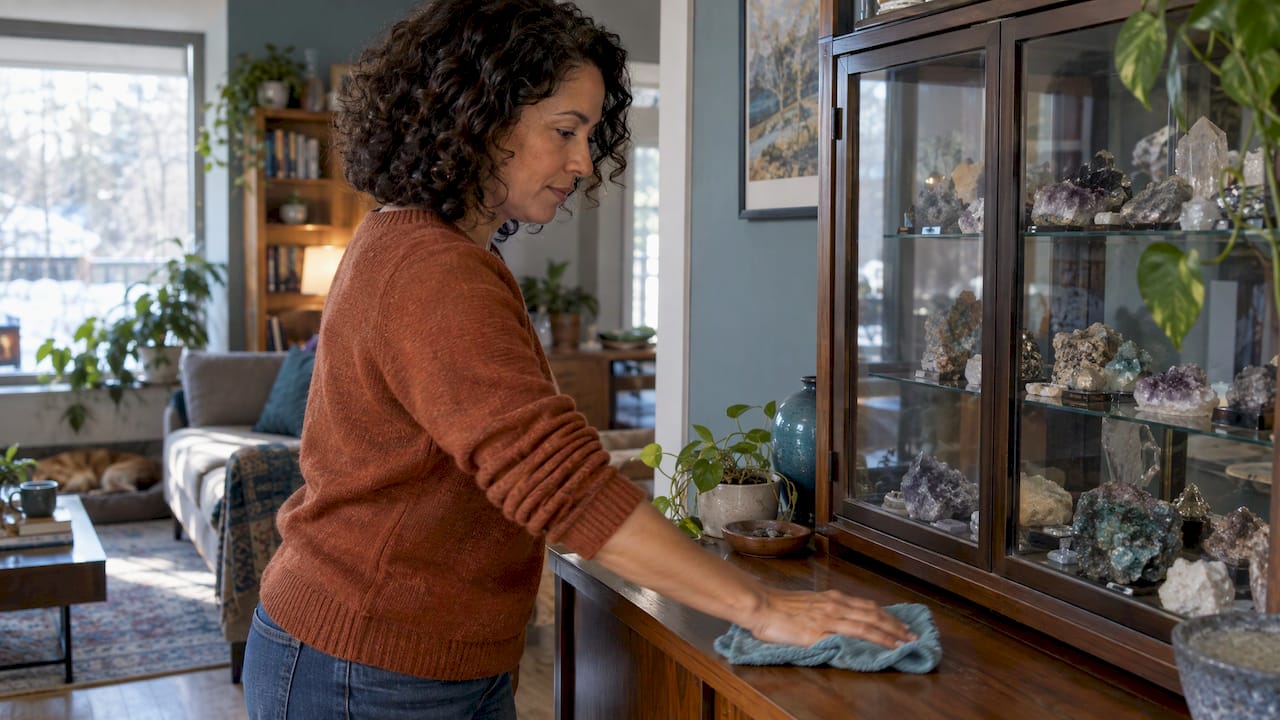
Dry methods avoid liquids that can dissolve, stain or crack a specimen. The same manual lists gentle brushing, vacuuming with a soft brush attachment and air from a photographer’s hand blower. A lapidary club guide recommends a soft camel-hair brush for tougher samples and says to avoid nylon or plastic brushes.
The Canadian Museum of Nature describes its own mineral cleaning with a fine brush and a vacuum with a nylon screen over the nozzle, so loose crystals are not sucked up. It also cleaned case exteriors and high areas first so dust settled before cases were opened. At home, the same order applies: dust the shelf and surroundings before you touch the specimen.
Take extra care with delicate forms
The lapidary guide warns that filamentary, fibrous or platy specimens are very delicate and that individual crystals can suffer severe damage if surface-attacking processes are used carelessly. For these, a puff of air is often the whole job.
If you must use liquid
- Choose the gentlest method and test it first. The US National Park Service cleaning sheet advises small test patches before cleaning the whole object and says never to use bleach, salt-laden cleaners, strong acids or bases, or harsh mechanical methods.
- If chemical stability is uncertain, test on a small discardable fragment.
- If you immerse a piece, keep liquid and rock at the same temperature to reduce thermal shock.
- Never add acid to arsenic-bearing minerals. It can release arsine gas.
Some minerals dissolve in water, and others fall apart when soaked. Identify the species before any wet cleaning. Our guide on how to clean crystals and mineral specimens safely covers the process in more detail.
Storing and displaying fragile minerals
Separate, pad, support
The CCI recommends keeping specimens apart in drawers, trays and containers, with inert foam or acid-free cardstock spacers. It also recommends padded supports for fragile items, foam density matched to object weight, padded shelves and work tables, and display mounts or retainers to reduce shock and vibration.
Avoid unstable foams, rubber bands, PVC, sticky tape and direct metal clips, which the Collectaneum guide warns against in storage.
Humidity matters for some species
The CCI notes that pyrite is vulnerable above 50% relative humidity. It oxidizes to bulkier iron sulfate, powders and disintegrates, and the acid by-products can destroy labels and boxes. Halite can begin to liquefy above 75% relative humidity, and borax dehydrates to tincalconite below 50%.
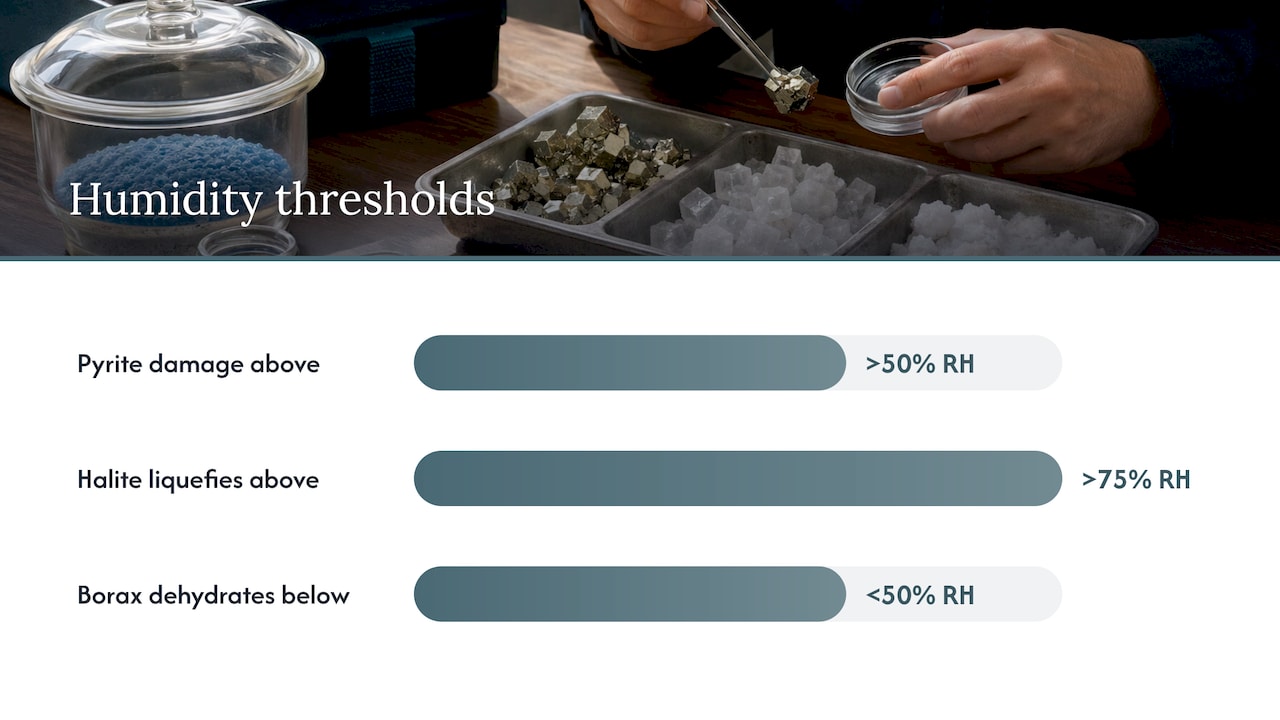
A geological conservation guide recommends keeping pyrite-bearing specimens at 45% relative humidity or lower. Our pyrite disease prevention guide goes through storage in detail.
Place specimens away from damp cupboards, bathrooms, radiators and windowsills, which swing in humidity and temperature.
Display with a barrier
Museum cases create a microclimate and keep dust off. The Canadian Museum of Nature notes that opening a case disturbs that microclimate. A closed cabinet or a plastic case at home does the same job on a smaller scale and keeps curious fingers away. For layout ideas, see our guide to displaying crystals at home and the caring for your specimens guide.
Moving and shipping delicate pieces
Museum standards say it is essential to protect specimens against shock and vibration at every stage, with soft, flexible packaging right next to the specimen.
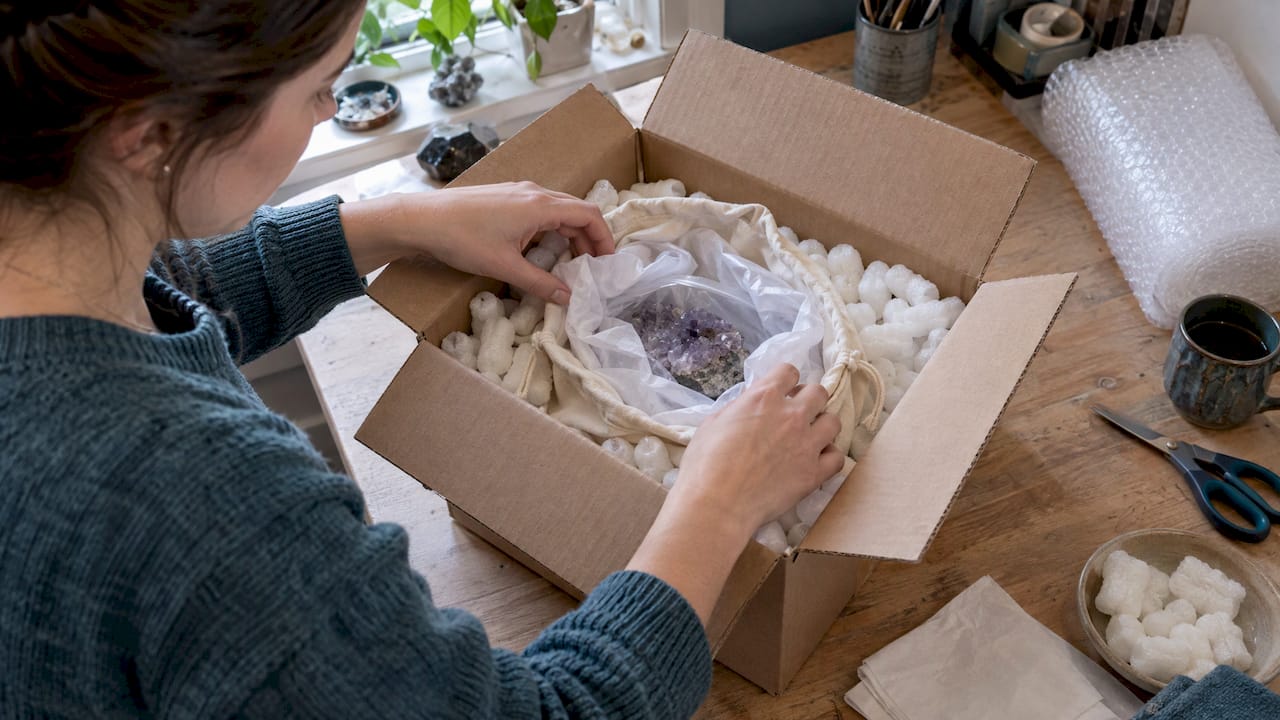
For transport, the Australian manual recommends wrapping specimens in acid-free tissue, placing them in labelled cotton or linen bags, and sealing those in polythene bags. For the most vulnerable pieces such as wulfenite and zeolites, it says open tissue-lined trays carried by hand may be the only practical method.
For parcels, give every specimen its own wrapping so pieces cannot touch, keep a clear gap between the specimen and the box wall, and fill voids so nothing shifts. Our guide to shipping mineral specimens covers the full packing routine.
Minerals that need safety precautions
Some fragile species are also hazardous. This is a handling matter, not a reason to avoid them.
- Toxic minerals. A museum conservation article lists arsenic, thallium, barium, bismuth, copper, fluorine, selenium and zinc compounds among potentially toxic minerals. Its advice: wear disposable gloves, wash your hands immediately afterward, never eat where they are kept, and label storage boxes clearly.
- Radioactive minerals. Uranium-series minerals also emit radon gas, which can build up in poorly ventilated rooms. The US National Park Service advises good ventilation to the outside and a regularly checked radon monitor where such minerals are kept. Radon settles to the lowest part of a cabinet or room, and distance from a specimen reduces exposure.
- Dust. The Canadian Museum of Nature uses N95 masks and protective equipment for minerals that release hazardous particulates when disturbed. Do dry brushing of such pieces outdoors or in a ventilated space.
Disposable nitrile gloves are a sensible default for any specimen you have not identified. If you are unsure whether a piece is radioactive or toxic, identify it before you handle it further.
Fixing, gluing and stabilizing
Coating a mineral usually lowers its value, according to a mineralogical society FAQ. The same page says small amounts of super glue can secure a crystal to its base.
Use a staged approach. The Collectaneum guide suggests you photograph all sides first, stabilize the setting, support and separate the specimens, and clean only when you understand how the material behaves. It recommends a specialist conservator for active pyrite decay, recurring salt deposits, powdering surfaces, unknown dust hazards, and valuable or provenance-bearing pieces. Photographs also help; see our mineral photography guide.
Choosing specimens you can handle with confidence
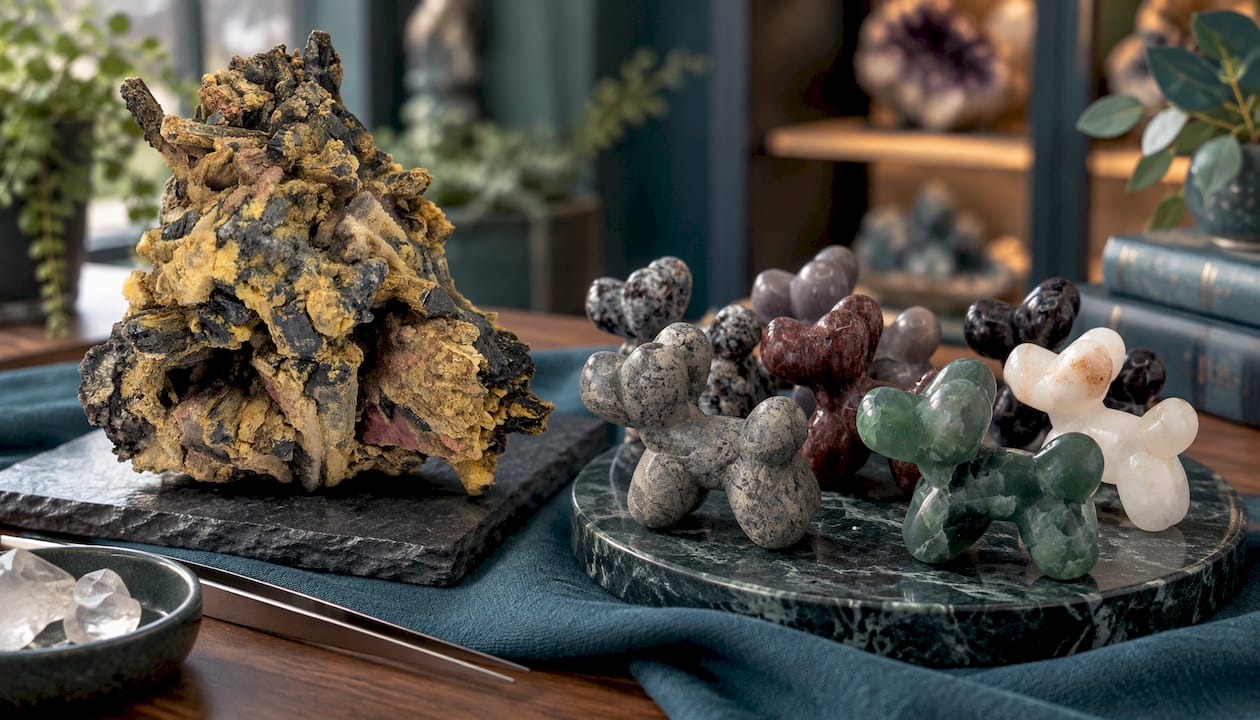
If you are building a collection, match the piece to how you will live with it. Polished stones and carvings tolerate more handling than needle clusters or thin blades. Raw specimens are best kept on a shelf and handled with the routine above.
Our range includes raw minerals and crystals, polished pieces, carvings and top shelf collector minerals. Our site also has a guide to building a museum-grade collection.
Browse the museum quality minerals and crystals collection for specimens suited to a protected shelf or case.
FAQ
Should I wear gloves to handle crystals?
Clean, lotion-free hands are enough for most stable specimens. Guidance for geological collections recommends disposable nitrile gloves for handling any specimen, and they are the right choice for toxic or unidentified pieces. Wash your hands afterward either way.
Can I wash a fragile mineral with water?
Only if you know the species. Some minerals dissolve or break down in water, so dry brushing and air are the safer start. Test a method on a small discardable fragment first.
What is the best way to store pyrite?
Keep it at 45% relative humidity or lower, separate from other specimens, in a dry spot. Humid conditions let pyrite oxidize and crumble, and the acid it forms can damage labels and boxes.
Can I lift a specimen by its crystals?
No. Hold the base or matrix, with both hands from below. Crystals, repairs and projections are the weakest points.
Sources
- Caring for natural history collections, Canadian Conservation Institute
- Stone, Minerals and Geological Materials, Collectaneum
- Geological Collections, Western Australian Museum manual
- Treatments, Western Australian Museum manual
- Standards in the Museum Care of Geological Collections, 2004
- Care and Use of Geological Collections, NatSCA
- Care and conservation of geological specimens, NatSCA
- Cleaning Minerals, Illawarra Lapidary Club
- A Mineral Cleaning Blitz, Canadian Museum of Nature
- NatSCA News, Issue 22
- Frequently Asked Questions, Mineralogical Society of America


