

Which crystals are water safe to rinse or soak?
If a crystal is hard enough, has no cleavage, and contains no reactive metal like copper, iron, or lead, you can rinse it. That includes quartz, amethyst, citrine, and most jasper. Soft or soluble stones, anything with visible cleavage planes, and metal-bearing minerals should stay dry.
Typically safe to rinse:
- Clear quartz, amethyst, citrine, smoky quartz
- Agate, jasper, tiger’s eye
- Aventurine, carnelian, rose quartz (short rinse only)
Two cautions before you run water over anything. Salt water is more aggressive than fresh water for many stones and can corrode metal jewellery findings. Second, a bracelet or pendant might use a water-safe stone but a glue, thread, or plated setting that isn’t, so treat mounted jewellery differently than loose specimens.
Key Takeaways
Water safety for crystals depends on hardness above Mohs 7, an absence of cleavage planes, and freedom from reactive metals like copper or lead.
| Point | Details |
|---|---|
| Use the Mohs 7 threshold | Quartz-family stones (Mohs 7) generally tolerate a quick rinse; anything under Mohs 5 usually doesn’t. |
| Check cleavage before hardness | Stones with flat, repeating cleavage planes, like mica or calcite, can split in water regardless of hardness. |
| Never soak toxic minerals | Malachite, azurite, and galena can leach copper or lead and should never contact drinking or bathing water. |
| Use sealed methods for gem water | Glass vials or mesh pouches keep stones separated from drinking water and avoid leaching risk entirely. |
| Match jewellery care to the stone | Legacy Crystals and Minerals documents hardness and cleavage per product, such as its quartz versus calcite bracelets. |
Table of Contents
- The quick rule and a 30-second water safe crystals test
- Why hardness, cleavage, and porosity decide what water does to a stone
- Water-safe crystals list: what you can rinse and how
- Crystals that should not go in water (and the toxic ones)
- Gem bottles and infused water: know the difference
- How to clean water-sensitive crystals without water
- What water does to crystal jewellery over time
- A one-page routine for safe crystal rinsing
- Legacy Crystals and Minerals: water-safe picks with documented care notes
- Primary sources on mineralogy and gem safety
- Sources
- FAQ
The quick rule and a 30-second water safe crystals test
The working threshold most collectors use is around Mohs 7. Quartz, which is hard, and most quartz-family stones handle brief water exposure without issue. Softer stones below about Mohs 5 can start absorbing water, dissolving, or crumbling at the edges. Exceptions exist both ways: very soft stones like selenite dissolve outright, while some stones with cleavage fail before hardness alone would predict.
Before you touch water, run this check:
- Look for cleavage lines. Flat, repeating, glassy planes across the surface suggest a mineral that splits cleanly, a warning sign regardless of hardness.
- Scratch test a hidden spot. A fingernail (about Mohs 2.5) or a coin (about Mohs 3.5) shouldn’t leave a mark on anything you plan to soak.
- Check for powder or chalkiness. If a light touch leaves dust on your fingers, the stone is porous or soft, and water will make it worse.
- Note any metallic flecks or unusual colour zoning. Coppery green, brassy gold, or dark metallic inclusions can mean reactive minerals underneath.
- If it passes all four, a quick rinse under cool tap water is reasonable. Skip full soaking unless you’ve confirmed the specific mineral tolerates it.
Pro Tip: Keep the water cold and the rinse under 30 seconds for your first test with any new specimen. Thermal shock from hot water cracks brittle stones faster than the moisture itself.
Why hardness, cleavage, and porosity decide what water does to a stone
Hardness on the Mohs scale of mineral hardness tells you how resistant a surface is to scratching, and it’s a decent first filter for water safety because soft stones tend to be more porous and chemically reactive too. It’s an imperfect proxy, though. Two minerals can share a hardness number and behave completely differently in water depending on their internal structure.
That structure comes down to cleavage versus fracture, and this distinction matters more than hardness alone. Cleavage is the tendency of a mineral to break along smooth planes of structural weakness; mica and calcite both have strong cleavage, which means water pressure, freezing, or even a temperature swing can pry a specimen apart along those planes. Quartz behaves differently. It shows conchoidal fracture, a curved shell-like break with no flat planes/03%3A_Mineral_Properties/3.05%3A_Strength_and_Breaking/3.5.02%3A_Cleavage_Fracture_and_Parting), which is part of why quartz-family stones tolerate handling and moisture so much better than mica or selenite. For collectors evaluating a raw specimen before cleaning, tenacity and cleavage quality (perfect, distinct, or indistinct) are often better predictors of whether it will flake than hardness alone, a point mineralogists rely on when assessing fracture and cleavage in the field.
Porosity and solubility explain the rest. Evaporite minerals like halite and gypsum formed by water evaporating out of a solution, so putting them back in water simply reverses the process, dissolving or crumbling them. Selenite, a gypsum variety, is the classic casualty here.
The last factor is chemistry. Stones containing reactive metals, like copper carbonates and sulphides, can oxidize or leach particles when wet, which may cause tarnish or health risks with repeated exposure.
Water-safe crystals list: what you can rinse and how
Most stones that pass the cleavage and hardness check share a family resemblance. They are part of the quartz group or a comparably hard, tightly bonded silicate. Here’s a practical rundown of common water-safe crystals, organized by what makes them reliable.
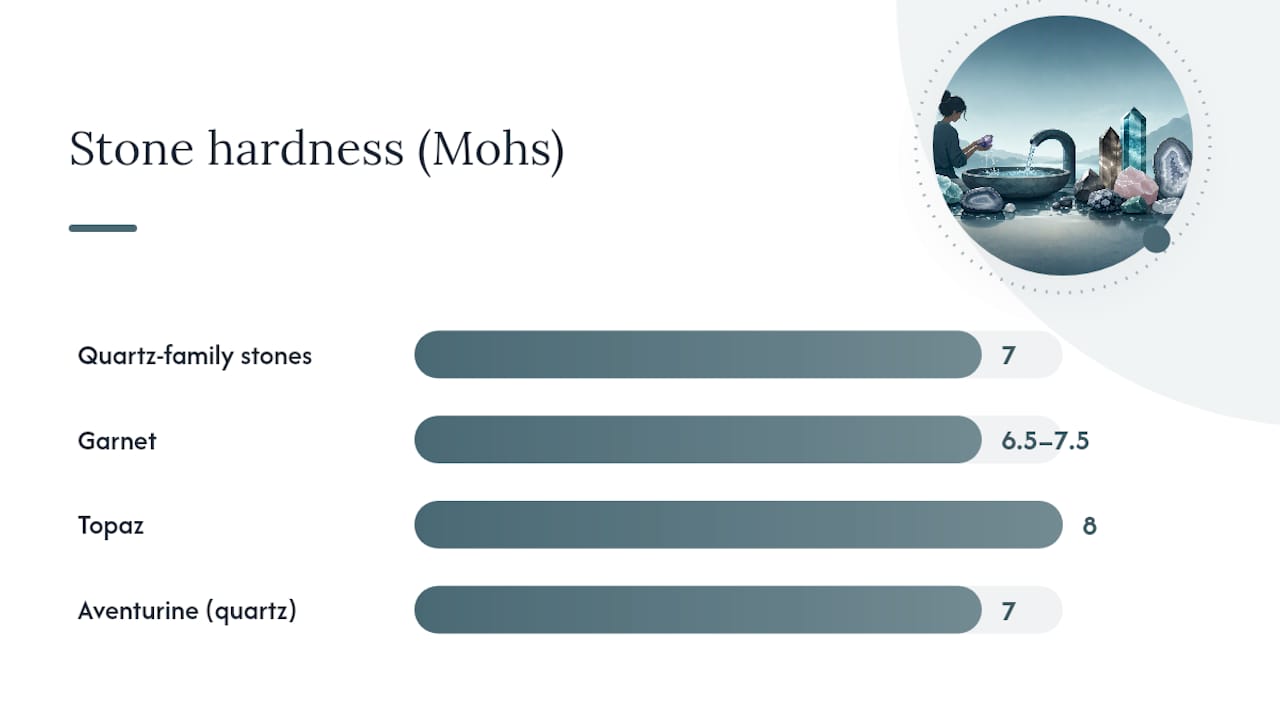
Quartz-family stones (Mohs 7):
- Clear quartz. No cleavage, conchoidal fracture, tolerates rinsing and short soaks well.
- Amethyst and citrine. Same crystal structure as clear quartz; colour comes from trace iron, doesn’t affect water tolerance.
- Smoky quartz. Identical hardness and fracture pattern; safe for regular cleaning.
- Rose quartz. Generally safe, though heavily included or fractured pieces can trap water in internal cracks. Dry thoroughly after rinsing.
- Tiger’s eye. A fibrous quartz variety, Mohs 7, but its silky banding can show water spotting if left wet too long.
- Agate and jasper. Cryptocrystalline quartz, extremely durable, among the safest stones to soak.
- Carnelian. Same family, safe for brief water contact.
Hard silicates outside the quartz group:
- Garnet (Mohs 6.5 to 7.5). No cleavage, generally water-tolerant, though some varieties have internal fractures worth checking first.
- Topaz (Mohs 8). Very hard, but it has perfect cleavage in one direction, so avoid dropping it or exposing it to sudden temperature shifts while wet.
- Aventurine. A quartz variety with mica inclusions; the base mineral is fine in water, but prolonged soaking can dull the mica sparkle over time.
Borderline items that need extra scrutiny: Dyed agates and howlite are common in jewellery, and dye can bleed or fade with repeated water exposure even though the base mineral is hard enough. Fracture-filled stones, often emerald or certain quartz treated to hide internal cracks, can develop cloudiness if the filler reacts with water. If a piece feels unusually light, shows uneven colour saturation, or came at a price that seemed too good for its size, ask about treatment history before soaking it. Treated stones can behave differently in water even when the base mineral is hard, which is why provenance and disclosure matter as much as the mineral name.
Two final caveats apply across this entire list. Salt water is harsher than tap water on nearly every stone, including quartz family members, because dissolved minerals in seawater can etch polished surfaces over repeated exposure. And thermal shock, moving a stone straight from a warm windowsill into cold tap water, causes more cracking than the water itself ever would.
Crystals that should not go in water (and the toxic ones)
Some minerals fail in water for structural reasons; others fail because they’re dangerous to handle wet. Both categories deserve a hard no.
Structural failures:
- Selenite and gypsum. Water-soluble; a soak will visibly etch or dissolve the surface within minutes.
- Halite (rock salt crystal). Dissolves in water almost immediately, by definition.
- Malachite. Soft (Mohs 3.5 to 4) and porous; water accelerates surface degradation and can pull colour.
- Lepidolite and other micas. Perfect cleavage means layers can separate and flake when saturated.
- Turquoise. Porous and often stabilized with resin; water can discolour or degrade the treatment.
- Angelite. A soft anhydrite mineral that dulls and can crumble with water exposure.
- Pyrite. Reacts with moisture and air, developing a corrosive coating over repeated wet cycles.
Toxic minerals, never for drinking water or topical use: Malachite and azurite contain copper carbonates that can leach into water. Galena is a lead sulphide, and cinnabar contains mercury. A gemstone toxicity table exists specifically because collectors and crystal healers have historically underestimated these risks, particularly with the trend toward gem-infused drinking water.
Some minerals dissolve or crumble outright in water, and copper or lead-bearing minerals like malachite, azurite, and galena can release particles into water that shouldn’t be touched repeatedly or ingested under any circumstance.
If a specimen you own starts flaking, powdering, or showing a chalky residue after accidental water contact, stop touching it with bare hands, let it dry completely away from other stones, and store it separately. Dispose of any crumbled fragments in household waste rather than a garden or compost bin, since some of these minerals aren’t meant to enter soil in concentrated form.
Gem bottles and infused water: know the difference
Direct-contact “crystal elixirs,” where a raw stone sits in the water you intend to drink, only make sense with stones that are both non-toxic and insoluble. Even then, most practitioners now avoid direct contact entirely because verifying a stone’s exact composition without lab testing is difficult.
- Sealed or indirect methods are the safer standard. Using a glass vial or sealed chamber inside the bottle keeps the stone separated from the water you drink, removing the leaching risk entirely.
- A mesh filter pouch works for external charging. Placing a wrapped stone around the outside of a bottle, rather than inside it, is sometimes called indirect charging and avoids any contact issue.
- Never use malachite, azurite, galena, cinnabar, or unidentified raw specimens in direct-contact bottles. If you can’t confirm a stone’s identity and hardness, treat it as unsafe for drinking water applications by default.
How to clean water-sensitive crystals without water
Soft, cleaved, or reactive stones still need cleaning, just not with a tap.
- Dry brush first. A soft-bristled paintbrush lifts dust from crevices without introducing moisture.
- Compressed air for detailed specimens. Works well on clusters and druzy pieces where a brush can’t reach.
- Smudging or sound cleansing for energetic upkeep. Sage smoke or a singing bowl won’t affect the mineral structure at all, making these the default choice for anything soft or soluble.
- Controlled sunlight or moonlight exposure. Fine for most stones overnight, but skip direct sun for amethyst, rose quartz, and other colour-sensitive stones, since UV exposure can fade them over time.
Choose dry brushing for anything under Mohs 5 or with visible cleavage, and reserve water for confirmed quartz-family and comparably hard, non-porous stones. For a daily routine, a quick wipe with a microfibre cloth after handling keeps oils and dust from building up, and it works on virtually every stone in a collection regardless of hardness.
Pro Tip: If a piece is part of a display collection rather than something you handle daily, a light dusting every few weeks is genuinely all it needs. Overhandling causes more wear than most people realize.
What water does to crystal jewellery over time
Bracelets and necklaces fail differently than loose specimens, because the weak point is usually the thread, glue, or metal finding rather than the stone itself. Elastic cord stretches and weakens with repeated water exposure, and metal-plated clasps or spacers can tarnish or discolour, especially in chlorinated pool water or salt water.
- Quartz-family bracelets (clear quartz, amethyst, tiger’s eye, agate) generally tolerate a quick shower or handwashing without issue, though prolonged submersion still isn’t recommended.
- Anything with a metal clasp, wire wrap, or glued element should come off before swimming, showering, or dishwashing regardless of the stone itself.
- Soft or cleaved stones set in jewellery (turquoise, howlite, lepidolite) should be removed before any water contact, full stop.
If a piece gets soaked by accident, remove it immediately, pat it dry with a soft cloth, and lay it flat on a towel away from direct heat. Avoid a hairdryer, which introduces the same thermal shock risk as hot water. Store it separately from other jewellery for a day to make sure it’s fully dry before it goes back in a pouch or box.
A one-page routine for safe crystal rinsing
Screenshot this before your next cleaning session.
Pre-check: scratch test, look for cleavage lines, check for chalkiness, note metallic inclusions. Safe rinse: cool water, under 30 seconds, no soap, no hot water. Dry: pat with a soft cloth immediately, air-dry fully before storage. Store: separately from soft or reactive stones, away from direct sunlight for colour-sensitive pieces.
| Hardness band | Recommended action |
|---|---|
| Soft (below Mohs 5) | Dry brush or smudge only, never soak |
| Borderline (Mohs 5 to 6.5) | Check cleavage and treatment history before any rinse |
| Hard (Mohs 7+, no cleavage) | Short rinse is generally fine, avoid salt water |
When in doubt about a specific stone, treat it as borderline and default to a dry cleaning method.
Legacy Crystals and Minerals: water-safe picks with documented care notes
Not every retailer tells you what’s actually safe to rinse and what isn’t, which leaves buyers guessing after checkout. Legacy Crystals and Minerals documents the hardness, structure, and care requirements for every piece it sells, so you’re not left cross-referencing a mineralogy chart after your order arrives.
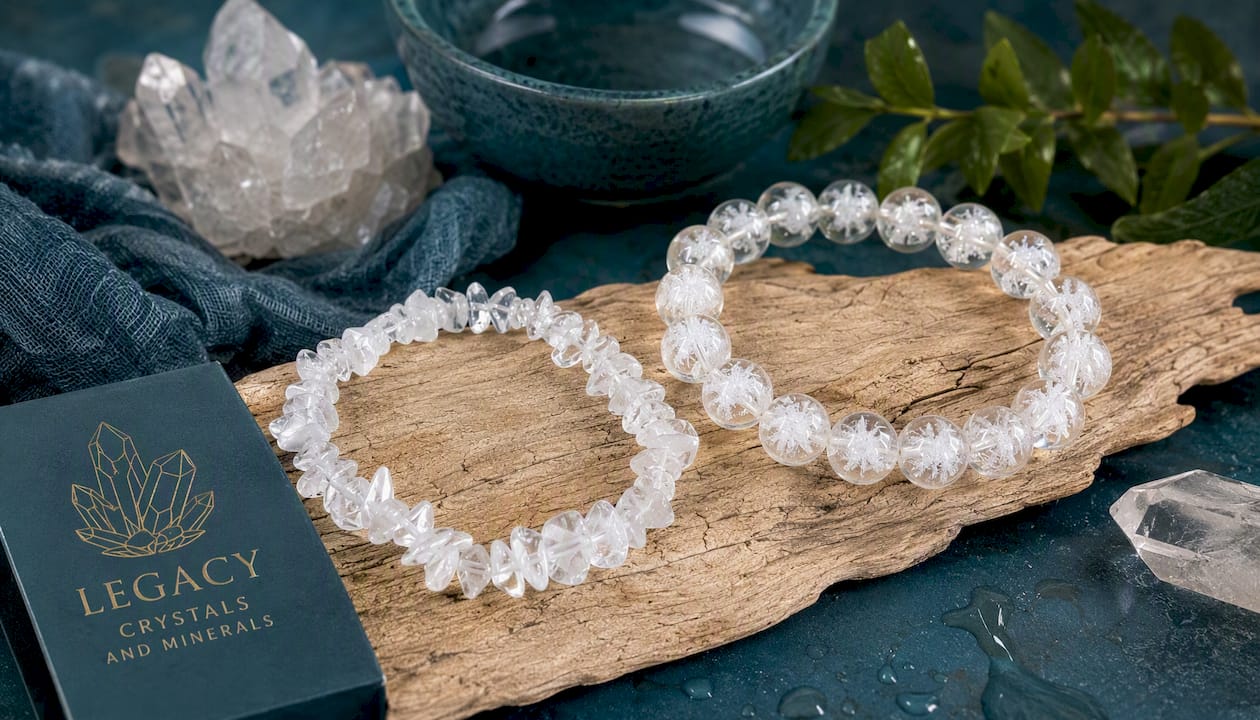
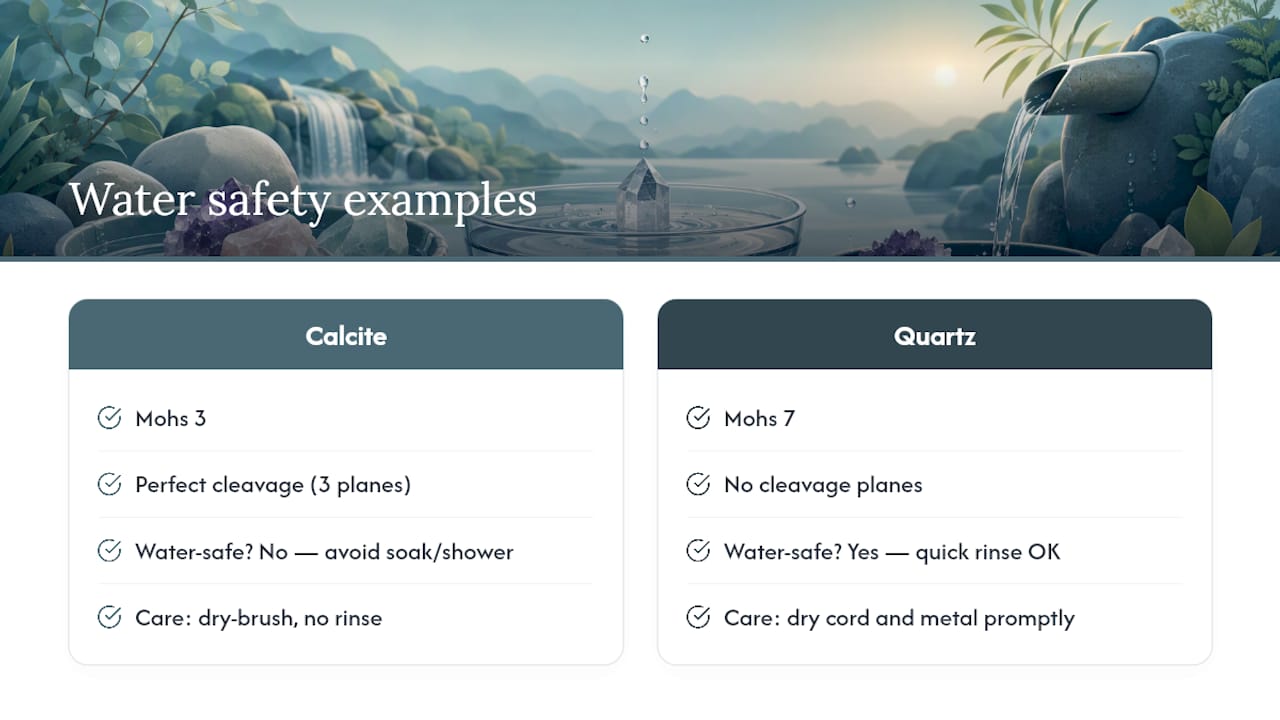
The Clear Calcite Chip Bracelet – Natural Translucent Stone is a good example of why hardness alone doesn’t tell the whole story. Calcite sits at only Mohs 3, with perfect cleavage in three directions, meaning this bracelet should stay away from soaking or showering entirely despite its clean, translucent look. It’s a dry-brush and smudge piece, not a rinse piece, and Legacy Crystals and Minerals notes that clearly on the product page.
The White Sea Urchin Quartz Bracelet – 12mm Polished Crystal | AAA Grade sits at the other end of the spectrum. As a quartz-family piece at Mohs 7 with no cleavage planes, it tolerates a quick rinse or an accidental splash far better than most jewellery in a typical collection, provided the elastic cord and any metal spacers are dried promptly afterward.
For the full breakdown of drying, storage, and display methods referenced throughout this guide, the complete crystal care guide covers specimen-specific instructions beyond what fits here. If you’re building a collection and want pieces with hardness and treatment details listed upfront, browse the current bracelet and specimen selection and check the care notes before you buy, not after something goes wrong in the sink.
Primary sources on mineralogy and gem safety
Sources
- Mindat
- Which crystals are safe to cleanse in water? — The Spiritual Gemmologist
- Gemsociety
- Conchoidal fracture — Wikipedia
FAQ
Which crystals should not go in water?
Selenite, halite, malachite, lepidolite, turquoise, and pyrite should stay dry, since they either dissolve, flake along cleavage planes, or corrode with moisture exposure.
Is it safe to put crystals in your drinking water?
Only quartz-family stones confirmed non-toxic and insoluble are considered for direct contact, and most practitioners now recommend sealed glass vials instead to avoid any leaching risk into water you’ll drink.
What crystals are commonly used with drinking water?
Clear quartz, amethyst, and citrine are the stones most often used in gem bottles, almost always inside a sealed vial rather than in direct contact with the water.
What crystal can’t touch water at all?
Selenite is the clearest example: it’s water-soluble gypsum, and even brief contact will etch or start dissolving the surface.
How do I know if my crystal is water safe?
Run a scratch test with a fingernail or coin, check for flat cleavage lines, and look for chalkiness or metallic flecks; if it passes all three, a short cool-water rinse is generally fine.
Recommended
- Crystals for meditation practices: a practical guide – Legacy Crystals and Minerals
- Crystal wand uses: practical routines for healing and massage – Legacy Crystals and Minerals
- Window crystals explained for crystal enthusiasts – Legacy Crystals and Minerals
- Crystals for anxiety: a practical guide for Canadians – Legacy Crystals and Minerals


