
Collectors: 3 Museum Grade Canadian Minerals With Provenance and Care
The specimen worth buying is the one with a documented locality, honest condition, and paperwork you can verify. Prioritise provenance over polish, check for hidden repairs before checking the price tag, and treat any Canadian mineral without a clear origin story as a discount, not a deal. Some dealers carry museum-grade Canadian specimens with the documentation this standard demands.
TL;DR:
- Provenance details such as exact locality, collection history, and old labels are crucial for verifying a specimen’s authenticity and future value.
- Condition inspections must include checking for chips, repairs, glue lines, and irregular growth faces to assess true specimen quality.
- Rarity of locality and crystal perfection influence value more than size or appearance alone, especially from defunct mines or rare regions.
- Buying from reputable dealers, auctions, or in person at mineral shows reduces risks, with documentation and return policies being essential safeguards.
- Proper storage in controlled humidity and light conditions is vital to prevent deterioration, especially for vulnerable minerals like pyrite, amethyst, and halite.
Table of Contents
- What to check before buying a Canadian mineral specimen
- How do you store and display Canadian minerals safely?
- How can you tell if a mineral specimen is fake or treated?
- Where should you buy museum-grade Canadian minerals?
- Where do Canada’s major mineral deposits sit geographically?
- Which Canadian minerals matter most to collectors?
- Why do Canadian minerals matter beyond the collector market?
- How are minerals actually extracted in Canada?
- What environmental rules govern Canadian mineral mining and collecting?
- Legacy Crystals and Minerals: curated Canadian specimens built on documented origin
- Sources
- FAQ
What to check before buying a Canadian mineral specimen
A specimen’s value lives in three places: where it came from, what condition it is really in, and how well both are documented. Skip any one of these and you are buying on faith.
Provenance comes first. Ask for the locality, the collection date, and any prior owners. Old collection labels and a clear chain of custody raise both credibility and resale value far more than a polished photo ever will. A Thunder Bay amethyst with a 1987 collector’s label and a documented mine closure date tells a story a generic “Canadian amethyst” listing cannot.
Condition needs a hard look, not a glance. Examine terminations for chips or dulling, check joins for glue lines under raking light, and flex-test nothing. Assembled or repaired specimens are common enough in the trade that a magnifier and a strong flashlight belong in every collector’s toolkit.
Aesthetic grading is where personal taste meets market reality. Crystal perfection, matrix contrast, and a strong focal point drive prices, and judging criteria used at mineral shows (labelling, identification, and crystal quality) map directly onto what a private buyer should evaluate before paying a premium. Rarity of locality matters too: a well-formed specimen from a defunct Canadian mine often outperforms a larger piece from an active, common source.
Benchmark against sold prices, not asking prices. Auction archives and dealer sale records tell you what buyers actually paid, which is often 20 to 40% below inflated asking prices on marketplace listings.
Before you commit to any purchase, request this documentation in writing:
- Species and variety name
- Exact locality (mine, township, or claim, not just “Ontario” or “Quebec”)
- Collection or acquisition date
- Any treatment disclosures (dyeing, heating, stabilizing)
- Provenance notes, including prior collections
Pro Tip: Ask the seller to photograph the specimen’s label alongside the piece itself. A label that has clearly travelled with the specimen for decades is harder to fake than a story told in a listing description.
Read more on what separates a display piece from a collector-grade specimen before you spend serious money.
How do you store and display Canadian minerals safely?
Not every mineral tolerates the same shelf. Pyrite and marcasite oxidize in humid air, amethyst and fluorite fade under sustained light, and halite can absorb ambient moisture and start to look cloudy within months of careless storage. Museum guidance recommends low light, stable moderate temperatures, and relative humidity controlled within a 30 to 60% range for species prone to corrosion or oxidation. That range is not a suggestion for pyrite specimens specifically. Pyrite oxidation is one of the most well-documented deterioration processes in mineral conservation, and it is largely irreversible once it starts.
Practical steps for a home collection:
- Segregate unstable species (pyrite, marcasite, some sulphides) into low-humidity storage separate from the rest of the collection.
- Use Perky boxes or custom acrylic mounts for stability, and add UV-filtering glazing to any case holding amethyst, fluorite, or other light-sensitive stones.
- Keep a silica-gel micro-environment inside sealed display cases for specimens sensitive to moisture.
- Pack specimens in acid-free tissue and rigid boxes for transport, never loose in bags where terminations can knock together.
- Maintain both a physical label and a digital catalogue entry (species, locality, date, source) for every specimen, so provenance survives even if a paper tag is lost.
More than 10% of known mineral species show vulnerability under typical storage conditions, and published conservation guidance still has gaps for many of them. That is reason enough to default to conservative care rather than assume a specimen is stable just because it looks fine today. If a piece is rare, high-value, or already showing instability, a professional conservator’s opinion is worth the consultation fee.
Legacy Crystals and Minerals’s own guide to shipping fragile specimens and its storage and display walkthrough both go deeper into materials and setups for Canadian collectors building out a display case.
How can you tell if a mineral specimen is fake or treated?
The Canadian mineral market has its share of dyed quartz, heat-treated amethyst sold under the citrine name, glued-together “specimens,” and even smelter slag or coloured glass passed off as natural crystal. None of these are always obvious in a listing photo, but a few checks catch most of them.
- Examine terminations closely: natural growth faces have subtle irregularities, while cut or reshaped points tend to look suspiciously uniform.
- Check where the specimen meets its matrix. A colour shift, a visible seam, or an odd angle often means the piece was assembled from two separate finds.
- Look for bubbles or tool marks, both signs of cast glass or resin rather than crystalline structure.
- Request high-resolution photos of the underside and the label. Sellers hiding these angles are worth extra skepticism.
- Compare the asking price against sold-price records. The market is full of manufactured, dyed, and assembled specimens, and an outlier price, high or suspiciously low, is often the first tell.
- For anything above a few hundred dollars, ask for a short video call or professional photos rather than relying on a static listing.
Walk away from any deal with undocumented repairs, no provenance on a supposedly rare Canadian locality, or locality claims that do not match the mineral’s known geological character. Legacy Crystals and Minerals has published a step-by-step guide to spotting fake crystals online and a companion piece on telling natural from synthetic material if you want the visual checklist alongside this one.
Where should you buy museum-grade Canadian minerals?
Four channels dominate the Canadian market, and each carries different trade-offs.
- Specialist e-commerce dealers tend to offer the strongest documentation and clearest return policies, since their business depends on repeat collectors trusting the listing.
- Auctions give you access to sold-price history in real time, useful for benchmarking, but buyer’s premiums and limited inspection windows raise the risk on unseen flaws.
- Mineral shows let you inspect a specimen in hand before paying, which remains the gold standard for condition checks, though provenance paperwork is not always offered unprompted.
- Private sales can surface rare Canadian locality pieces at fair prices, but they carry the weakest built-in consumer protection if a claim turns out to be wrong.
On pricing, expect locality rarity, crystal perfection, and clean provenance to justify a premium over comparable-looking pieces without that backing. Within Canada, fragile specimens should ship in rigid, cushioned packaging with declared value and insurance matching the sale price. Legacy Crystals and Minerals’s shipping guide covers the packing standards worth expecting from any seller.
Before committing, ask any seller for documentation, a clear return policy, an authenticity guarantee, and photos of the specimen’s label. Legacy Crystals and Minerals’s own collector’s guide to specimen types and value lays out what that documentation should look like on a product page.
Where do Canada’s major mineral deposits sit geographically?
Canadian mineral wealth clusters around a handful of major geological zones, and knowing them helps you judge whether a locality claim on a listing is even plausible. The Canadian Shield, stretching across Ontario, Quebec, Manitoba, and into the territories, hosts much of the country’s garnet, quartz, and base-metal mineralization, including the River Valley area in Ontario known for almandine garnet. The Saskatchewan potash basin, centred on Saskatoon and the surrounding mining district, produces evaporite minerals like halite in distinctive blue and pink hues rarely seen outside that formation.
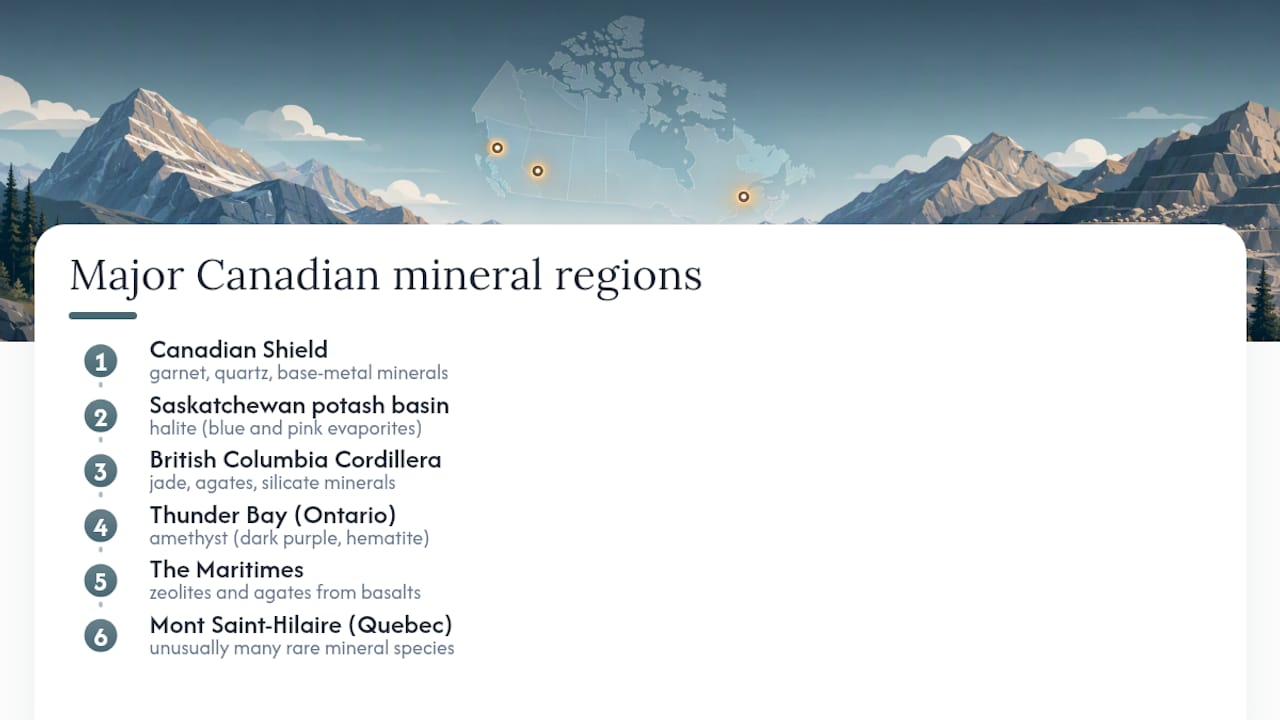
British Columbia’s Cordillera holds a different mineral character entirely, shaped by volcanic and metamorphic activity that produces jade, agates, and a range of silicate minerals. Thunder Bay, Ontario, remains one of the most recognized sources of fine amethyst in the country, prized for its dark purple colour and occasional hematite inclusions. The Maritimes contribute zeolites and agates tied to their basalt formations, while Quebec’s Mont Saint-Hilaire is internationally known among mineralogists for an unusually large number of rare mineral species found in one location.
Each of these regions produces specimens with recognizable traits, colour, crystal habit, matrix type, that experienced collectors use to sanity-check a locality claim before ever seeing a lab report.
Which Canadian minerals matter most to collectors?
A short list of Canadian minerals carries outsized significance among collectors, either for rarity, visual character, or the fact that a locality produces almost nothing comparable elsewhere.
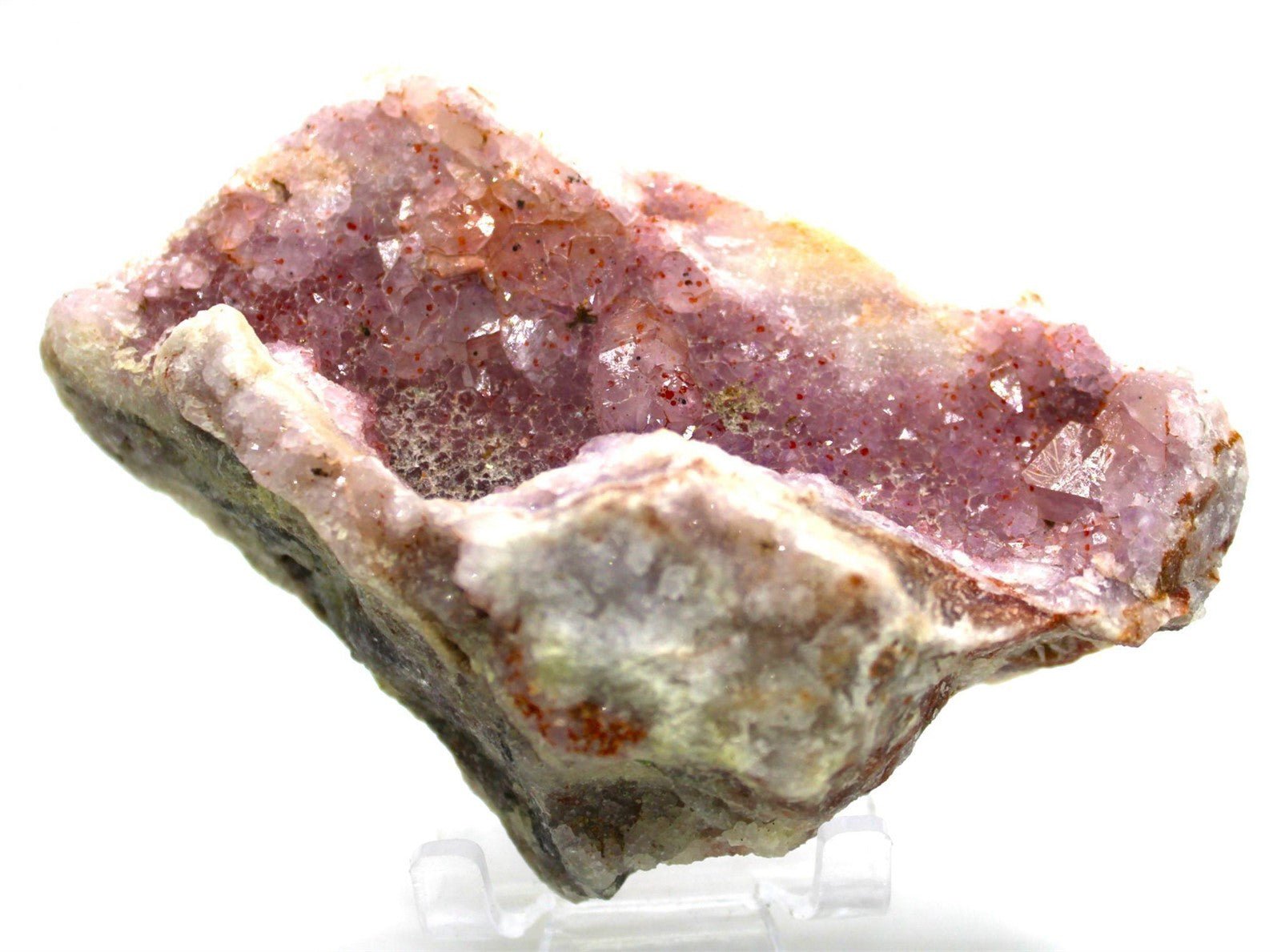
Thunder Bay amethyst stands near the top, especially pieces showing the hematite-tinted crystallization that distinguishes Ontario material from amethyst sourced elsewhere. Saskatchewan blue halite, formed within the province’s potash mining district, offers a colour and clarity rarely matched by evaporite minerals from other regions. River Valley almandine garnet, from the Ontario locality of the same name, produces well-formed, deep red crystals that collectors seek for both their geometry and their matrix presentation.
Beyond these three, Mont Saint-Hilaire in Quebec has yielded more distinct mineral species than almost any other single locality on Earth, making even modest specimens from that site collectible on rarity alone. Labradorite, first identified and named after Labrador, remains one of Canada’s most recognizable mineral exports thanks to its distinctive light-refracting colour play. Nickel-copper sulphide specimens from Sudbury, Ontario, tied to one of the world’s largest impact-related ore bodies, round out the list of Canadian minerals with a story worth documenting alongside the piece itself.
Why do Canadian minerals matter beyond the collector market?
Canada’s mineral wealth underpins entire regional economies well outside the collector trade, and understanding that context helps explain why documented locality matters so much. The mining industry in Canada supports employment across dozens of communities built directly around ore bodies, from Sudbury’s nickel operations to Saskatchewan’s potash towns. Natural resources in Canada, including minerals, metals, and industrial materials, remain a foundational export category, with entire supply chains, rail lines, ports, and processing facilities built to move raw material to global markets.
For collectors, this economic backbone has a practical upside: active mining regions generate a steady, traceable supply of fresh specimens with clear locality records, while depleted or closed mines produce the scarcity that drives long-term value. A specimen pulled from a mine that closed decades ago carries a finite, non-renewable supply story that active sites simply cannot match. Mineral exploration in Canada continues to open new ground each year, which means today’s obscure locality can become tomorrow’s sought-after source, or vice versa, as deposits are worked out. That shifting landscape is part of why provenance documentation only grows more valuable with time rather than less.
How are minerals actually extracted in Canada?
Extraction method shapes a specimen’s condition long before it ever reaches a collector’s shelf, and it is worth understanding the basics. Open-pit mining, used extensively for base metals and some industrial minerals, tends to produce larger blast-damaged material with fewer intact crystal specimens surviving the process intact. Underground mining, common in hard rock operations across the Canadian Shield, allows for more selective extraction and is where many of the finest crystal specimens, garnets, quartz, and sulphide minerals, are hand-collected from pockets and vugs rather than mechanically blasted.
Solution mining, used in Saskatchewan’s potash operations, dissolves the mineral layer underground and pumps the brine to the surface, a process that occasionally yields the distinctive blue halite crystals collectors seek when clean crystal pockets are encountered during conventional shaft work. Placer methods, historically significant for gold and still used in parts of British Columbia and the Yukon, sift loose material from riverbeds rather than blasting solid rock.
Each method leaves a signature on the resulting specimens. Hand-collected underground finds tend to show sharper terminations and less mechanical damage than material recovered from bulk blasting operations, which is one more reason extraction context belongs in a seller’s documentation alongside locality and date.
What environmental rules govern Canadian mineral mining and collecting?
Provincial and federal regulations govern nearly every stage of mineral extraction in Canada, and collectors benefit from that oversight even when buying specimens years after they left the ground. Mining companies operating in Canada must meet environmental assessment requirements, reclamation obligations, and water management standards before, during, and after active extraction, rules that vary by province but generally require restoring disturbed land once a site closes. Sustainable mining practices in Canada increasingly include tailings management and habitat restoration commitments that extend well past the working life of a mine.
Canadian mineral rights themselves are typically held separately from surface land rights, meaning a claim holder can extract minerals from beneath land they do not own the surface of, subject to provincial mining acts and compensation requirements. For collectors, this matters most at the point of acquisition: legitimate collecting on active claims requires permission from the rights holder, and specimens from closed or historic mines often carry clearer legal collecting history than material pulled from an active, permitted operation without documented consent. Buying from a dealer who can speak to how a specimen was collected, not just where, adds a layer of assurance that goes beyond simple locality naming.
Legacy Crystals and Minerals: curated Canadian specimens built on documented origin
Some niche dealers specialise in museum-grade crystals and minerals, with a focus on authenticity, rarity, and scientific provenance rather than volume retail. This focus can be seen in the Canadian specimens offered.
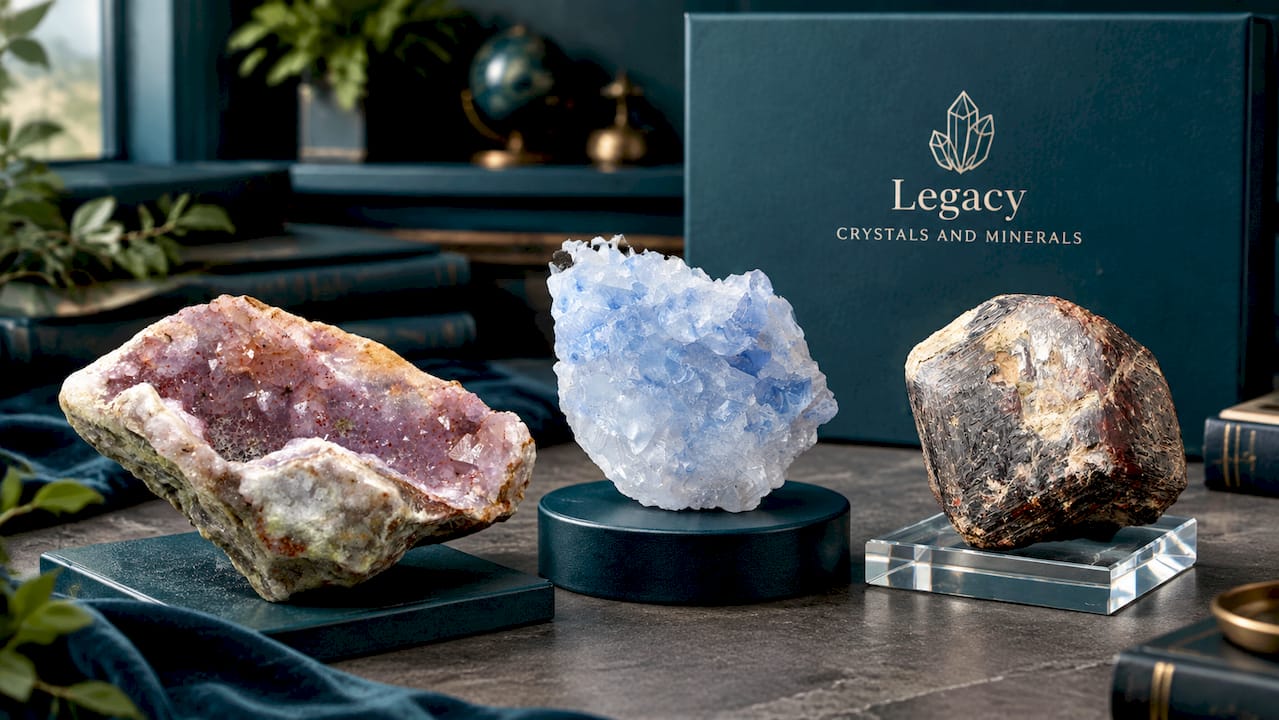
The Canadian Amethyst with Hematite-Tinted Crystallization shows the locality-specific colour and inclusion pattern collectors look for in genuine Ontario material. The Standard Blue Halite from Saskatchewan’s Potash Mining District represents a locality most collections outside Canada never encounter in this quality. The Almandine Garnet from River Valley, Ontario, weighing 286 grams at 5 x 5 x 4 centimetres, gives you the size and crystal geometry that separates a display piece from a filler specimen.
Listings may include provenance notes with packaging and shipping guidance, sometimes supported by customer service and educational resources. Browse the current Canadian selection and check the documentation on any listing before you add it to your collection.
Sources
For deeper guidance on the standards behind this article, museum conservation practices for humidity and light control come from the Western Australian Museum’s handling manual and the NatSCA review of geological collection care. Provenance and sold-price benchmarking guidance draws from the Intelligent Collector’s fine mineral guide and EarthWonders’s guide to buying minerals online. Legacy Crystals and Minerals’s guide to building a museum-grade collection extends much of this into practical next steps.
- The Museum Manual — Handling, packing and storage (Western Australian Museum)
- Caring for geological collections: unresolved questions (Royce & Baars, JoNSC)
- Collector’s guide to fine minerals (Intelligent Collector)
- How to buy minerals online without getting burned (EarthWonders blog)
FAQ
What makes a Canadian mineral specimen collector-grade?
Crystal perfection, strong matrix contrast, a clear focal point, and rarity of locality all factor in, alongside documented provenance and an absence of undisclosed repairs.
How do I verify a specimen’s provenance before buying?
Ask for the exact locality, collection date, old collection labels, and any prior ownership history, then compare the seller’s asking price against sold-price records for similar pieces.
What humidity level is safe for storing Canadian minerals?
Museum guidance recommends relative humidity between 30 and 60% for species prone to corrosion or oxidation, with pyrite and marcasite requiring the driest end of that range.
How can I tell if amethyst has been heat-treated and sold as citrine?
Heat-treated amethyst sold as citrine often shows an unnaturally uniform orange-brown colour without the zoning natural citrine typically displays, so request high-resolution photos and ask directly whether the piece has been treated.
Where can I buy authentic Canadian mineral specimens with documentation?
Some specialty retailers list museum-grade Canadian specimens, including Thunder Bay amethyst, Saskatchewan blue halite, and Ontario almandine garnet, often accompanied by provenance notes and care guidance on their product pages.


