

Cabochon vs faceted: how to choose the right gemstone cut
Faceted cuts maximize internal brilliance and suit transparent, clean stones. Cabochons emphasize colour, texture, and optical effects, and suit opaque or inclusion-rich material. Use this rule of thumb when comparing cabochon vs faceted options for a specific piece:
- Choose faceted for transparent, inclusion-free stones where sparkle and fire matter most (diamond, clean sapphire, emerald).
- Choose cabochon for opaque or translucent stones, or anything showing a phenomenon like asterism, chatoyancy, or opal’s play-of-colour.
- Exceptions exist. Some translucent or phenomenal stones look better domed even when they could technically be faceted, and cost depends far more on material rarity and cutting labour than on the cut style itself.
Key Takeaways
Transparency and inclusion visibility, not personal preference, determine whether a stone should be faceted or cabbed.
| Point | Details |
|---|---|
| Match cut to clarity | Faceting suits clean, transparent stones; cabbing suits opaque or included material. |
| Phenomena need a dome | Asterism, chatoyancy, and opal’s play-of-colour only survive as cabochons. |
| Hardness affects the choice | Stones under roughly 7 on the Mohs scale are commonly cabbed to resist chipping. |
| Setting should follow cut | Bezel settings protect cabochons; open prong settings let faceted stones show brilliance. |
| Legacy Crystals and Minerals matches finish to material | The catalog favours polished cabochon-style beads and uncut raw specimens over faceting for most stones. |
Table of Contents
- Cabochon meaning: form, proportions, and why cutters choose it
- Faceted stones: facets, cutting styles, and what faceting achieves
- How light behaves differently in each cut
- Which gemstones are usually cabbed and which are usually faceted
- A quick checklist for choosing a cut
- Durability, care, and what really drives price
- How Legacy Crystals and Minerals applies these cutting principles
- Find your next piece at Legacy Crystals and Minerals
- Sources
- FAQ
Cabochon meaning: form, proportions, and why cutters choose it
A cabochon is a smooth, domed shape with a flat or slightly curved base and no facets at all. The dome sits above the base like a rounded hill, most often shaped into an oval or elliptical outline, though round, freeform, and marquise cabochons show up regularly too. Cutters call this style “cabbing,” and the GIA’s definitions of gem cutting styles draw a clean line between it and faceting: one is engineered for light refraction, the other for colour and texture.
Dome height changes what you see. A taller dome deepens colour saturation and can concentrate a star or eye effect into a tighter, more dramatic band. A shallower dome spreads colour more evenly but softens phenomenal effects.
- Cabbing suits opaque and translucent material.
- It hides inclusions that would look distracting under facets.
- It’s the only practical way to display asterism or chatoyancy.
Pro Tip: If a stone shows a faint star or eye effect in rough form, hold it under a single point light source and rotate it slowly before deciding on dome height. The angle where the effect sharpens tells the cutter exactly where to centre the dome.
Faceted stones: facets, cutting styles, and what faceting achieves
A faceted gemstone carries multiple flat, polished faces cut at calculated angles, usually somewhere between 31 and 73 facets depending on the design, according to the GIA. Each facet acts as a small mirror, and their combined geometry controls how light bounces and exits the stone.
Three cutting styles dominate the trade:
- Brilliant cut (round brilliants, ovals, cushions) maximizes sparkle through triangular and kite-shaped facets.
- Step cut (emerald, baguette) uses parallel rectangular facets for a cleaner, less fiery look.
- Mixed cut blends both, often a brilliant crown over a step-cut pavilion.
Faceters have to match pavilion and crown angles to the gem’s refractive index, as explained in this step-by-step diamond selection guide for UK buyers, or light escapes through the bottom instead of bouncing back to the eye, a flaw cutters call a “window.” That precision, along with the material lost to grinding flat facets, makes faceting slower and more skill-intensive than cabbing, a gap confirmed by industry comparisons of faceted versus cabochon cutting.
How light behaves differently in each cut
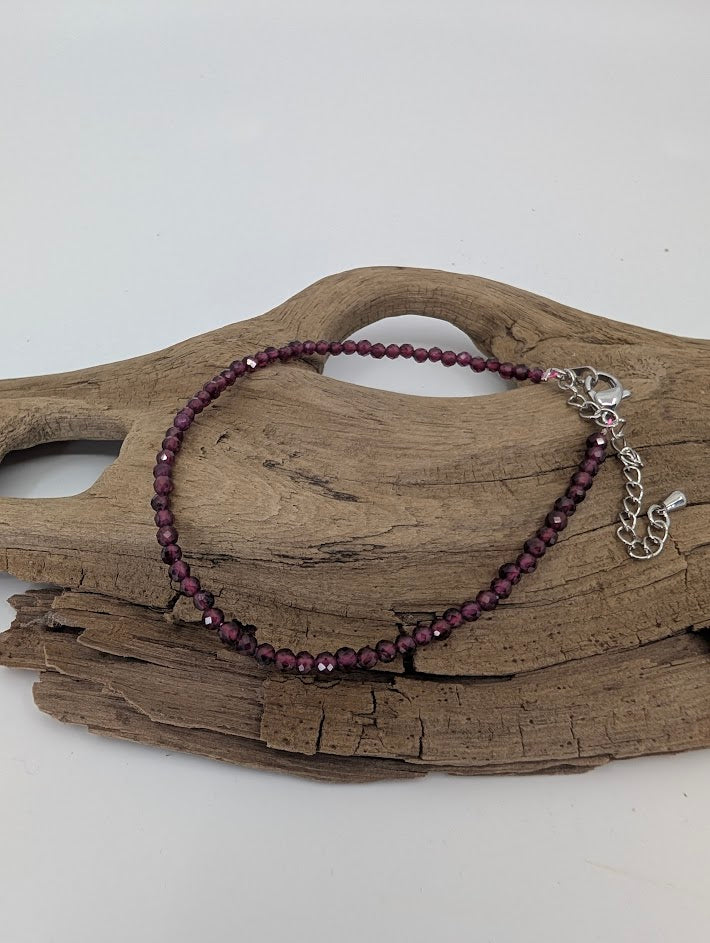
Faceted stones rely on total internal reflection. Light enters through the crown, bounces off the angled pavilion facets, and exits back through the top as brilliance and, in dispersive stones like diamond, spectral fire. This only works when the stone is transparent enough for light to travel through it cleanly, which is why faceting depends so heavily on a gem’s critical angle and clarity.
Cabochons work on surface reflection instead. Light hits the domed surface and either scatters across included fibres (chatoyancy), reflects off oriented needle inclusions in a star pattern (asterism), or diffracts through microscopic silica spheres to produce opal’s shifting colour. None of that survives faceting. Cut a fine black opal into facets and the play-of-colour disappears; cut a star sapphire the same way and the star vanishes entirely.
Cabochon cutting preserves optical effects like asterism and chatoyancy, and it was historically the default method before modern faceting techniques existed, according to Wikipedia’s overview of the cabochon cut.
Rough that could theoretically go either way often reveals its best cut only once a cutter examines it under light. A cat’s-eye chrysoberyl faceted for brilliance loses the very feature that makes it valuable, while a clean, eye-free chrysoberyl faceted well can rival a fine yellow sapphire in sparkle. The same crystal, cut two different ways, can land in completely different value brackets.
Which gemstones are usually cabbed and which are usually faceted
Transparency drives most of this decision, and gem dealers treat it as close to a hard rule: clean, transparent rough gets faceted; opaque or included rough gets cabbed.
Common cabochon stones:
- Opal, for its play-of-colour (see how it compares with opalite)
- Moonstone, for its blue sheen (adularescence)
- Turquoise, jasper, and malachite, all opaque with strong colour or pattern
- Tiger’s eye, for chatoyancy created by parallel fibrous inclusions
Common faceted stones:
- Diamond, sapphire, and ruby, all transparent with high refractive indices
- Emerald and spinel, faceted despite frequent inclusions because their colour saturation still rewards light play
- Topaz, prized for clarity and dispersion
Borderline cases exist. Some tourmaline crystals carry enough clarity for faceting but enough colour zoning that cutters occasionally cab them instead to keep the zoning intact. If you’re evaluating a piece with visible colour bands, it helps to understand how tourmaline varieties differ before assuming faceting is the only option. Agate, similarly, gets both treatments depending on banding and translucency, which is worth checking against guidance on spotting dyed versus natural agate.
A quick checklist for choosing a cut
Run through these five questions before committing a stone to either treatment:
- Is it transparent? Clean, see-through material generally rewards faceting.
- Are inclusions visible to the naked eye? Visible inclusions often look better softened under a dome.
- What’s the Mohs hardness? Softer stones (below 7) tend to hold up better as cabochons.
- What effect are you after? Sparkle points to faceting; colour depth or phenomena point to cabbing.
- What’s the budget? Cabbing wastes less material and takes less cutter time, which usually keeps costs down.
Setting choice should follow the cut. Cabochons pair naturally with bezel settings, since a closed metal rim protects the domed edge and hides the flat back. Faceted stones need open galleries or prong settings that let light enter from underneath and escape through the crown, since boxing in a faceted stone kills the brilliance it was cut for.
Pro Tip: Designs that combine both cuts, a faceted centre stone surrounded by cabbed accent stones, work well when you want sparkle at the focal point and colour depth around it. Tell your cutter or jeweller which role each stone plays before cutting begins, not after.
Durability, care, and what really drives price
A cabochon’s rounded dome resists chipping better than a sharp facet edge, and minor surface scratches tend to disappear into the curve rather than catching light the way they would on a flat facet. That’s a large part of why stones under roughly 7 on the Mohs scale get cabbed so often; opal, turquoise, and malachite are all soft enough that a domed polish protects them far better in daily wear than sharp facets would.
Faceted stones show scratches more readily on their flat faces, but hard, durable material (diamond, sapphire, ruby) can usually be re-polished to restore its finish.
Price comes down to labour and rarity, not the cut style in isolation:
- Faceting costs more in cutter time and wastes more rough material.
- Cabbing wastes less material but can command a premium when the phenomenon is rare, such as a strong six-ray star sapphire.
- Material quality, not the choice between cabochon vs faceted, is usually the bigger price driver overall.
How Legacy Crystals and Minerals applies these cutting principles
Simon, a contributor at Legacy Crystals and Minerals, applies this same logic when selecting which finish suits a piece before it ever reaches the catalog. Faceting only makes sense on clean, transparent rough, so most mineral specimens and beaded jewellery in the collection use polished, cabochon-style finishes instead, letting natural colour and pattern do the work.
- The White Sea Urchin Quartz Bracelet uses polished 12mm beads to showcase quartz’s natural clarity without cutting away material for facets.
- The Dragon Bloodstone Beaded Bracelet relies on epidote jasper’s dense colour pattern, which a polished round finish shows off better than faceting ever could.
- The Garden Quartz Bracelet carries visible internal inclusions that a rounded polish frames rather than hides.
- Raw specimens like the Black Tourmaline (Schorl) Raw Specimens and the Stibnite with Sulfur, Quartz & Realgar Alteration specimen are left uncut entirely, since faceting would destroy the natural crystal formations collectors actually want to see.
| Legacy Crystals and Minerals example | Why this finish |
|---|---|
| White Sea Urchin Quartz Bracelet | Polished beads highlight quartz clarity without facet waste |
| Dragon Bloodstone Beaded Bracelet | Polished round beads show epidote jasper’s colour pattern |
| Garden Quartz Bracelet | Rounded polish frames visible internal inclusions |
| Black Tourmaline Raw Specimens | Left uncut so natural crystal form stays intact |
Find your next piece at Legacy Crystals and Minerals
Once you know whether a stone calls for a dome or a facet, the next step is finding a piece that already gets that choice right. Legacy Crystals and Minerals curates polished bracelets, raw specimens, and carved pieces where the finish was chosen to match the material, not forced to fit a trend.
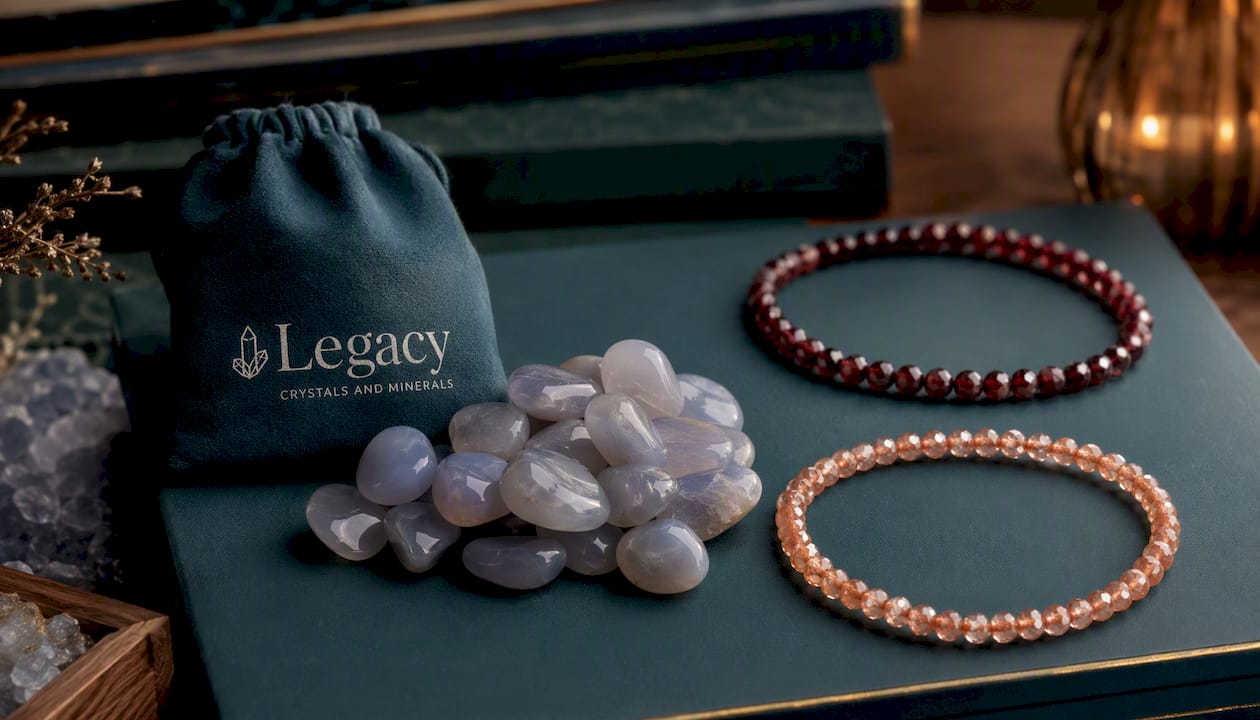
Collectors who want the pattern and colour depth that only cabbing can deliver will find it in pieces like the Coral Jade Bracelet and the Milk Jade Bracelet, both polished in rounded bead form to show off colour saturation the way this guide explains. If you’d rather see a stone in its natural, uncut state, the Mystery Crystal Tower and the Pyrite and Quartz on Blue Gibbsite specimen show mineral formation exactly as it grew.
Browse the full mineral specimen and bracelet collection at Legacy Crystals and Minerals to find a piece cut and finished the right way for its material.
Sources
FAQ
Why are cabochons so cheap?
Cabbing wastes less rough material and takes less cutter time than faceting, which keeps base prices lower. Price rises sharply, though, when a cabochon shows a rare phenomenon like a sharp asterism or fine chatoyancy.
Are cabochons more expensive than faceted stones?
Generally no. Faceting requires more skill, more time, and more material loss, so a faceted stone of similar rarity often costs more, though rarity of the raw material can outweigh cut style entirely.
What are the different types of cabochons?
Common shapes include oval, round, elliptical, and freeform cabochons, with dome height varying from low and flat to high and rounded depending on the desired colour depth or phenomenal effect.
What does it mean if a stone is faceted?
A faceted stone has multiple flat, polished surfaces, typically between 31 and 73 facets, cut at precise angles to reflect and refract light for maximum brilliance and sparkle.
Recommended
- Opal vs opalite: what every buyer needs to know – Legacy Crystals and Minerals
- Raw crystal jewellery vs polished: how to choose for wear and energy – Legacy Crystals and Minerals
- Carving quality in crystals: a technical guide – Legacy Crystals and Minerals
- Agate vs jasper: the collector’s identification guide – Legacy Crystals and Minerals


