

Agate teinte ou naturelle : vérifications rapides pour les collectionneurs
Si la couleur s'accumule dans un trou de forage, se trouve anormalement profondément dans une fracture, ou semble fluo par rapport au reste de la pierre, il s'agit très probablement d'agate teintée, et non d'un spécimen de couleur naturelle. Le test le plus rapide consiste à vérifier un trou de forage ou un bord ébréché sous une loupe de 10x : le colorant s'y concentre car l'agate absorbe la couleur de manière inégale à travers ses pores et ses fissures.
Trois choses à faire immédiatement :
- Examinez tout trou de forage ou bord exposé pour y déceler une couleur plus foncée ou plus dense que la surface.
- Vérifiez si la couleur est parfaitement uniforme sur l'ensemble de la pièce ou d'un collier assorti.
- Frottez un endroit caché avec un coton imbibé d'un peu d'acétone ou d'alcool isopropylique pour voir si la couleur se transfère.
- Inspectez d'abord, avant d'acheter ou avant de cataloguer une pièce déjà en votre possession.
- Combinez au moins deux vérifications. Un seul indice prouve rarement quoi que ce soit.
- Envoyez-la à un laboratoire si la valeur de la pierre justifie le coût.
Table des matières
- Agate teintée ou naturelle : les indices visuels qui la démasquent
- Vérifications simples à faire à la maison, que tout le monde peut effectuer en toute sécurité
- Comment les gemmologues et les laboratoires confirment la teinture
- Repérer les imitations : verre, résine et howlite teintée
- Ce que la teinture signifie pour la valeur, la divulgation et l'entretien
- Votre liste de contrôle avant l'achat et les questions à poser au vendeur
- Déterminer le statut de traitement de l'agate par la provenance, la divulgation et les tests, et non par la couleur seule
- Où trouver de l'agate en laquelle vous pouvez avoir confiance
- Sources
- FAQ
Agate teintée ou naturelle : les indices visuels qui la démasquent
La couleur naturelle de l'agate a tendance à être plus discrète : des gris doux, des beiges et des bleus créés à partir de traces de fer et de manganèse traversant les bandes de silice au cours du temps géologique. L'agate teintée a généralement des couleurs qui n'apparaissent pas ainsi dans la nature : bleu électrique, vert émeraude, rouge cerise et un noir presque laqué. VelvetMatter énumère ces quatre tons saturés (bleu, vert, rouge et noir dense) comme les signes avant-coureurs les plus courants dans les matériaux teints, et recommande de vérifier les trous de forage et les fractures pour y déceler une couleur concentrée plutôt que de se fier uniquement à la saturation.
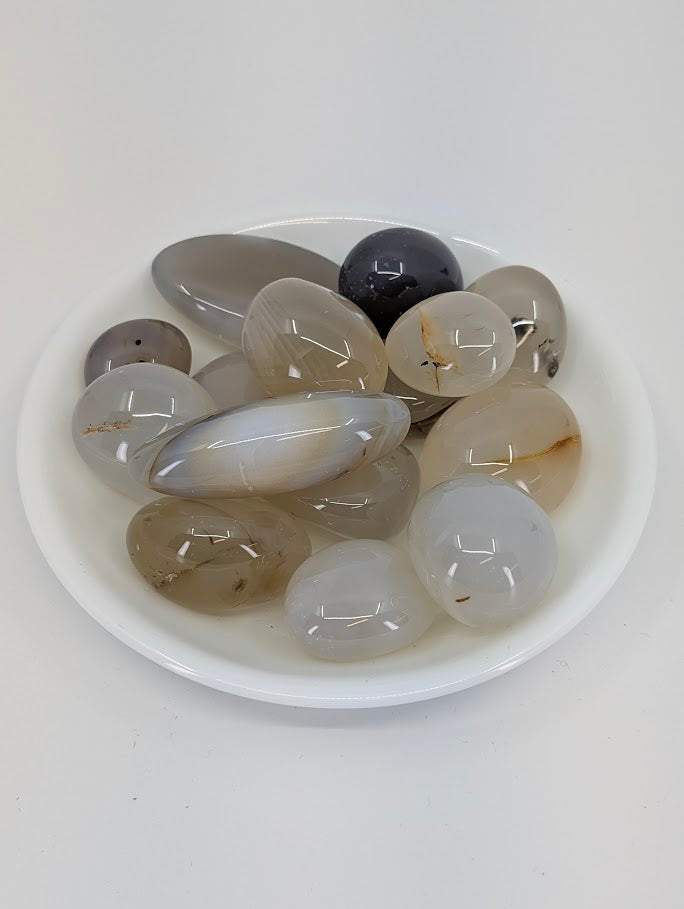
L'endroit où vous regardez est aussi important que ce que vous voyez. Une couleur qui s'accumule visiblement dans un trou de forage, le long d'une ligne de fracture, autour de la tranche d'une perle ou au bord d'une tranche coupée est un indice important, car le colorant pénètre par les points faibles et la structure des pores plutôt que de se répartir uniformément comme le fait la couleur minérale naturelle. Un guide d'identification destiné aux fournisseurs fait la même remarque : une couleur visiblement plus foncée ou plus concentrée près des trous de forage et des éclats que sur la surface environnante signale généralement une teinture.
Le comportement des bandes est un autre indice. Les bandes d'agate naturelles présentent des changements de tons graduels, une nuance se fondant dans la suivante sur toute la largeur d'une bande. Les bandes teintes ont souvent un aspect plat et uniforme au sein de chaque bande, avec une limite abrupte, presque peinte, entre les couleurs au lieu d'une transition douce.
Des perles parfaitement assorties sur un fil, toutes partageant le même ton et la même saturation, sont l'un des signes pratiques les plus clairs de teinture. La nature produit rarement ce genre de cohérence sur des dizaines de pierres taillées dans différents nodules.
L'uniformité sur un lot mérite d'être mentionnée, car c'est l'indice que les collectionneurs négligent le plus souvent. Un fil de perles de couleur bleu néon assortie indique généralement qu'elles ont été teintes ensemble, car les nodules d'agate naturels varient suffisamment en contenu minéral pour qu'un tel assortiment visuel soit très rare. Aucun de ces indices ne fonctionne seul. Un seul trou de forage foncé pourrait refléter un zonage minéral naturel plutôt qu'un colorant, et même des acheteurs expérimentés se font parfois tromper par un indice isolé. Traitez chaque observation comme un point de données, et non comme un verdict.
Vérifications simples à faire à la maison, que tout le monde peut effectuer en toute sécurité
Vous n'avez pas besoin d'un laboratoire pour confirmer ou infirmer vos soupçons. Ces vérifications utilisent des outils que la plupart des collectionneurs possèdent déjà, et aucune d'entre elles n'endommagera une pierre authentique si vous êtes prudent.
- Examen à la loupe. Une loupe de 10x révèle ce que votre œil nu ne voit pas : les bandes de couleur à l'intérieur des trous de forage, les résidus de colorant dans les pores de surface et les fissures capillaires où le pigment s'est déposé. Regardez spécifiquement la zone de transition entre le canal foré et la surface extérieure.
- Test au coton-tige imbibé de solvant. Humidifiez un coton-tige blanc avec de l'acétone ou de l'alcool isopropylique et frottez-le délicatement sur un endroit discret, idéalement à l'intérieur d'un trou de forage ou à l'arrière d'un cabochon. Si la couleur se transfère sur le coton-tige, vous avez affaire à une pierre teintée. Cela fonctionne parce que de nombreux colorants de surface se trouvent à la surface du minéral plutôt que de s'y lier, bien que certains colorants inorganiques soient formulés pour résister entièrement à ce type de transfert, selon l'aperçu de Gem-A sur les méthodes de teinture.
- Vérifications de l'éclairage. Comparez la pierre sous une lumière du jour diffuse, une lampe de poche directionnelle forte et une lampe UV si vous en avez une. Le colorant apparaît souvent comme une couleur plate et opaque sous une lumière directe forte, tandis que l'agate naturelle laisse généralement la lumière pénétrer de quelques millimètres et présente une structure interne subtile.
- Inspection des rayures et de l'usure. Vérifiez tout bord usé, petit éclat ou ancienne rayure. Si la couleur intérieure en dessous est nettement plus pâle que la surface, la couleur est probablement un traitement de surface peu profond plutôt que quelque chose qui traverse la pierre.
Conseil de pro : N'utilisez jamais d'acide, d'eau de Javel ou de flamme nue pour tester l'agate. Les acides peuvent graver la surface de manière permanente, et la chaleur peut fracturer la pierre, détruisant sa valeur, que la pièce soit teintée ou non.
Comment les gemmologues et les laboratoires confirment la teinture
Les gemmologues qualifiés disposent d'outils bien plus sophistiqués qu'une simple loupe et un coton-tige. L'examen microscopique à fort grossissement révèle des motifs de concentration de colorant invisibles à l'œil nu. La spectroscopie visible et infrarouge peut détecter les signatures d'absorption spécifiques que les colorants synthétiques laissent derrière eux, ce que Gem-A note s'applique à de nombreux matériaux gemmes, pas seulement à l'agate. L'imagerie avancée peut également retracer la profondeur de pénétration d'un colorant dans la pierre par rapport à sa simple présence en surface.
- Examen microscopique : repère l'accumulation de colorant dans les fractures et les pores à des grossissements bien supérieurs à ceux d'une loupe à main.
- Spectroscopie : identifie les signatures chimiques spécifiques aux colorants synthétiques plutôt qu'aux oligo-éléments naturels.
- Imagerie avancée : cartographie la profondeur réelle de la couleur dans la pierre.
Les tests en laboratoire sont pertinents pour les pièces dont la valeur dépasse quelques centaines de dollars, les spécimens de provenance importante, les pièces de succession sans papiers, ou tout ce que vous prévoyez de revendre et où la divulgation est importante sur le plan légal et réputationnel. Pour un bracelet de perles à 15 $, le coût n'en vaut pas la peine. Pour un spécimen sculpté rare ou une pièce de collection importante, un rapport s'amortit de lui-même.
Conseil de pro : *Comparez les frais de laboratoire à la valeur déclarée de la pierre, et non à sa valeur émotionnelle pour vous.
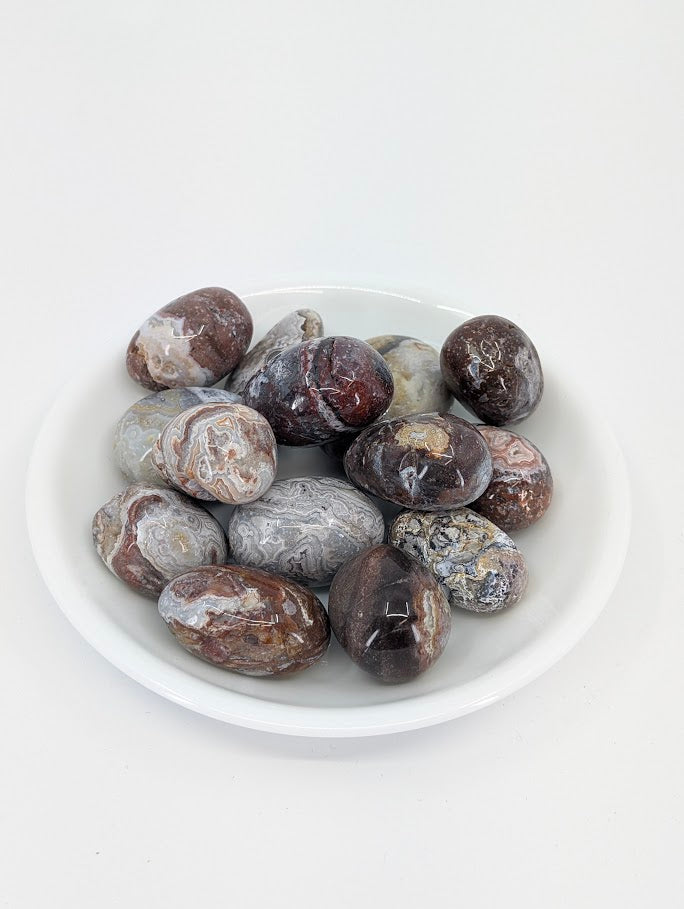
Recherchez les sources de rapports nommées : un rapport d'identification GIA ou un laboratoire gemmologique qualifié équivalent nomme explicitement tout traitement détecté plutôt que de simplement classer la pierre. Combinez cela avec une politique de retour du vendeur claire, et vous avez une réelle protection si la divulgation s'avère erronée.
Repérer les imitations : verre, résine et howlite teintée
Avant même de vous demander si la couleur est naturelle, assurez-vous que le matériau de base est bien de l'agate. Les imitations en verre et en résine reproduisent les motifs de bandes de manière convaincante à première vue, mais se comportent différemment au toucher. Le verre est froid et se réchauffe rapidement ; l'agate reste froide plus longtemps en raison de sa densité. Le verre et la résine piègent aussi souvent des bulles d'air, visibles sous grossissement, et présentent des lignes de moule là où deux moitiés d'un moule de coulée se sont rencontrées.
- Poids et température : le verre et la résine sont plus légers et se réchauffent plus vite dans la main que l'agate véritable.
- Motifs répétés : des bandes identiques sur plusieurs pièces "différentes" indiquent un moule, pas un nodule naturel.
- Éclat de surface : un lustre trop vitreux, semblable à du plastique, suggère de la résine plutôt que du chalcédoine polie.
- Bulles d'air : visibles sous une loupe, elles excluent totalement une origine minérale naturelle.
L'howlite et la magnésite teintées posent un problème distinct. Ce sont deux minéraux légitimement différents, teints pour imiter la turquoise ou d'autres pierres, et leurs motifs naturels de veines grises restent souvent visibles à travers la teinture, ainsi qu'une texture plus crayeuse et poreuse que l'agate véritable ne présente jamais. Si vous ne savez pas comment séparer la question du matériau de base de la question de la couleur, la même logique s'applique aux autres pierres traitées. Notre guide sur l'identification de l'agate par rapport au jaspe vous aide à confirmer le minéral lui-même avant de vous soucier du traitement.
Ce que la teinture signifie pour la valeur, la divulgation et l'entretien
L'agate teintée reste de l'agate véritable. Minéralogiquement, rien dans le traitement ne change la nature de la pierre, selon l'analyse de VelvetMatter sur l'agate teintée en joaillerie, c'est pourquoi une divulgation appropriée est plus importante que le traitement lui-même. Ce qui change, c'est la position sur le marché : les couleurs naturelles rares commandent une prime précisément parce qu'elles sont peu communes, tandis que le matériau teint est tarifé pour le marché de la conception et de la joaillerie en volume, et non pour sa rareté.
La stabilité varie selon la méthode. Les colorants inorganiques modernes, y compris les techniques développées dans les centres de taille de gemmes comme Idar-Oberstein, peuvent être effectivement permanents. Les traitements plus anciens ou moins profonds, y compris certaines méthodes de noircissement à base de sucre et d'acide encore utilisées aujourd'hui, sont plus proches de la surface et s'estompent ou se transfèrent plus facilement.
- Évitez les trempages prolongés, les solvants puissants et les nettoyants abrasifs sur toute pièce teintée.
- Nettoyez avec une brosse douce, du savon doux et de l'eau, puis séchez immédiatement plutôt que de laisser sécher à l'air libre.
- Conservez les pièces teintes à l'abri de la lumière directe du soleil, qui peut accélérer la décoloration des teintures moins stables.
Conseil de pro : Si vous n'êtes pas sûr qu'une pièce soit teintée, nettoyez-la comme si elle l'était. Un nettoyage doux ne nuit jamais à une pierre naturelle, mais un nettoyage agressif peut détériorer une pierre traitée.
En tant que guide de prix, attendez-vous à ce que les couleurs rares non traitées comme la dentelle bleue naturelle ou la belle agate mousse se vendent à un prix élevé, tandis que les fils teints et les cabochons calibrés se situent dans le bas du marché, vendus sur la couleur et la cohérence plutôt que sur la rareté.
Votre liste de contrôle avant l'achat et les questions à poser au vendeur
Quelques minutes de questions avant d'acheter vous évitent une supposition coûteuse plus tard.
- Demandez directement si la pièce est teinte, imprégnée ou reconstituée.
- Demandez une photo en gros plan d'un bord non percé, d'un éclat ou de l'intérieur de la pierre.
- Demandez un rapport de laboratoire pour tout article dont le prix est celui d'un spécimen rare ou de grande valeur.
- Confirmez la politique de retour du vendeur avant de vous engager.
- Envoyez vos questions au vendeur par écrit afin d'avoir une preuve si la réponse s'avère erronée.
- Comparez leur réponse avec ce que vous voyez sur les photos qu'ils fournissent.
- Évitez les réponses vagues comme « c'est juste de la couleur naturelle » sans gros plans ou documentation à l'appui.
Un vendeur qui hésite à montrer un bord non percé ou refuse une politique de retour sur une pierre prétendument rare vous dit quelque chose, qu'il s'en rende compte ou non.
Déterminer le statut de traitement de l'agate par la provenance, la divulgation et les tests, et non par la couleur seule
Distinguer l'agate teintée de l'agate naturelle se résume à combiner l'inspection visuelle, les tests de solvant et d'éclairage à domicile, et la divulgation du vendeur plutôt que de juger uniquement par l'intensité de la couleur.
| Point | Détails |
|---|---|
| Vérifier d'abord les trous de forage | L'accumulation de couleur dans les trous de forage ou les fractures est l'indice le plus rapide et le plus fiable à domicile. |
| Combiner plusieurs tests | Un examen à la loupe, un test au tampon solvant et un contrôle de l'éclairage sont plus efficaces qu'un seul test. |
| Adapter la valeur aux tests de laboratoire | Réservez la spectroscopie ou les rapports de niveau GIA aux pièces de plus de quelques centaines de dollars ou d'importance pour les collectionneurs. |
| Confirmer d'abord le matériau de base | Excluez le verre, la résine ou l'howlite teintée avant de débattre si la couleur de l'agate est naturelle. |
| Acheter du naturel là où la rareté compte | Legacy Crystals and Minerals s'approvisionne en agates naturelles vérifiées pour les collectionneurs qui recherchent une couleur documentée et non traitée. |
Où trouver de l'agate en laquelle vous pouvez avoir confiance
Trier les tests de teinture et les examens à la loupe devient vite fastidieux, surtout si vous voulez juste une pièce en laquelle vous pouvez avoir confiance sans transformer chaque achat en un exercice de police scientifique. Legacy Crystals and Minerals s'approvisionne en spécimens d'agate, sculptures et bijoux avec la provenance et l'authenticité au premier plan, afin que vous ne dépendiez pas des angles de photo d'un inconnu ou d'un langage vague pour prendre votre décision.
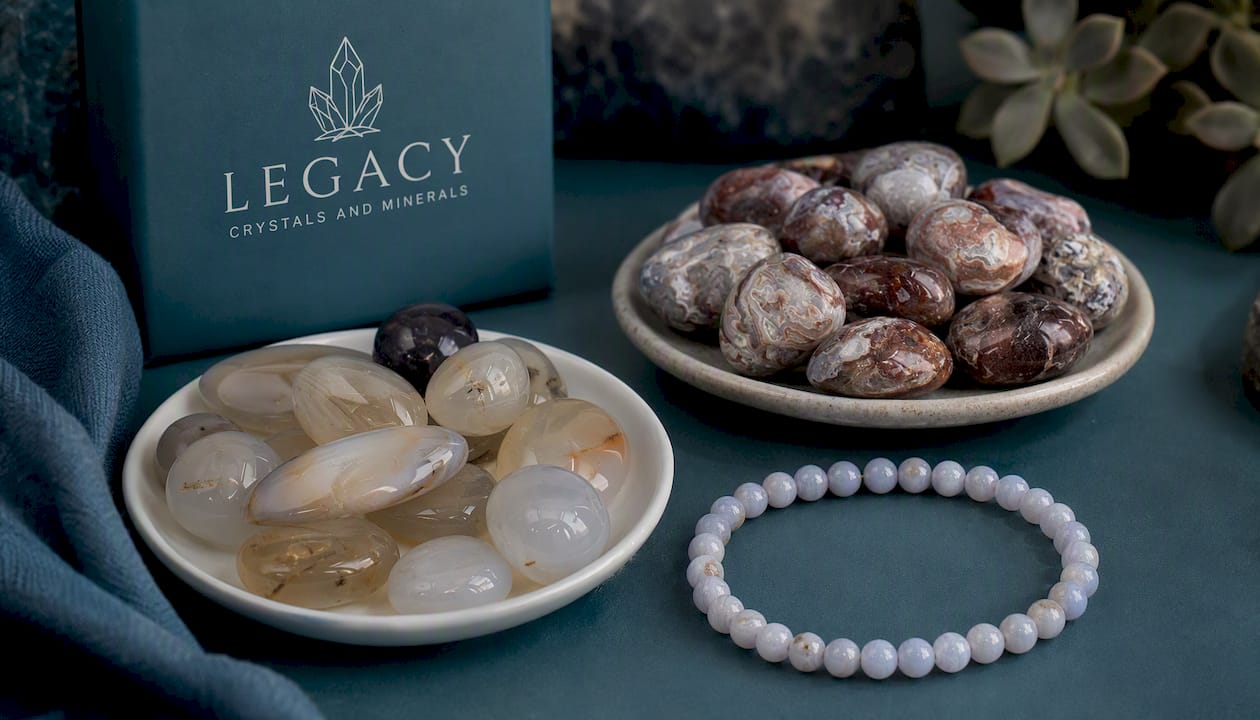
Pour les collectionneurs qui recherchent des pièces de couleur naturelle plutôt que des perles teintées du marché de masse, parcourez des spécimens comme le Crâne d'agate drusée, une pièce sculptée de collection où la couleur et la formation naturelles font partie de l'attrait, et non quelque chose que vous devez vérifier vous-même. Si vous recherchez des pièces à porter, le Bracelet en agate Crazy Lace montre le type de variation de bandes naturelles que cet article vient de vous apprendre à rechercher. Et si votre intérêt se porte sur d'autres styles de bijoux, le Bracelet en jade corail vaut le détour. Quelle que soit la pièce qui attire votre attention, consultez la description du produit pour les détails d'approvisionnement, puis ajoutez-la à votre collection en sachant exactement ce que vous obtenez.
Sources
Pour une vérification plus approfondie, Gem-A couvre la chimie des colorants et la permanence à travers les matériaux gemmes, Gemology Online documente les recettes historiques de teinture d'agate, VelvetMatter explique les implications pour le marché et la divulgation, et GIA décrit ce qu'un rapport de laboratoire professionnel confirme réellement.
- Gemmology Insights: Comment reconnaître les pierres précieuses teintes et ce qu'il faut rechercher | Gem-A
- Velvetmatter
- Perles d'agate naturelles : comment identifier la couleur d'agate teintée – The Bead Traders
- Pierre précieuse lapis-lazuli | Guide de l'acheteur GIA
FAQ
Comment savoir si l'agate a été teinte ?
Vérifiez le trou de forage, les lignes de fracture ou un bord ébréché pour une couleur plus foncée ou plus concentrée que la surface environnante, puis confirmez avec un test au coton-tige imbibé de solvant en utilisant de l'acétone ou de l'alcool isopropylique sur un endroit caché.
L'agate teintée a-t-elle de la valeur ?
L'agate teintée est toujours de l'agate véritable minéralogiquement, mais elle se vend généralement moins cher que les couleurs rares non traitées car les collectionneurs et les acheteurs paient une prime pour la rareté naturelle, et non pour la couleur améliorée.
Quelle est la couleur la plus rare d'agate naturelle ?
La rareté varie selon la région et la formation, mais l'agate bleue naturelle et la fine agate mousse avec des motifs de couleur forts et inhabituels ont tendance à atteindre les prix les plus élevés parmi les spécimens non traités.
Quelle est la signification spirituelle de l'agate teinte ?
De nombreux praticiens attribuent les mêmes associations d'ancrage et d'apaisement à l'agate teinte qu'à l'agate naturelle, car le minéral sous-jacent est identique. Le traitement de la couleur ne modifie pas la composition de la pierre, seulement sa valeur marchande et l'importance de la divulgation.
Recommandé
- Agate vs jaspe : le guide d'identification du collectionneur – Legacy Crystals and Minerals
- Comment distinguer le vrai jade du faux : un guide pratique – Legacy Crystals and Minerals
- Comment identifier les cristaux naturels et synthétiques – Legacy Crystals and Minerals
- Crâne d'agate druse — 4,3 kg (6 × 5 × 8 po) - Legacy Crystals and Minerals – Legacy Crystals and Minerals


